Category: Social Media Tips

  • How to Grow a Small Business on TikTok

    How to Grow a Small Business on TikTok

    You’ve finally done it: you’ve created a TikTok account — congratulations! Now before we get into the tactics you can use to grow your small business’s TikTok, let’s talk a little about how the platform works.

    With over 800 million active users globally, TikTok is the world’s fastest-growing social media networking and entertainment site. There are endless types of TikTok accounts! Everyone from Katy Perry to the Red Cross is using TikTok. 

    Showing off your camera abilities and practicing your immaculate dance moves is only part of what makes a successful TikTok strategy. You also need to understand the TikTok algorithm in order to get viewers to watch your videos and grow your account.

    Deciphering TikTok

    According to research conducted on TikTok’s demographics, 41% of users are between 16 and 24.

    If your intended audience is teens or young adults, now is the time to launch a TikTok account for your business. Because TikTok is still fresh and expanding, this is a once-in-a-lifetime chance to establish yourself in your field. 

    Formerly, posts could only be 15 seconds in length; however, TikTok recently increased the limit to 60 and 3 minutes by stringing together four 15-second chunks. 

    Music videos, lip-syncing, and trendy hashtag challenges are among TikTok’s most successful video content.

    How To Grow TikTok For a Small Business

    1. Publish Original and Interactive Content To Grow Your Small Business TikTok

    If you would like to expand your small business on TikTok, you should upload consistent content that can be considered an asset to your customers. If your business targets kids and teens, choose videos with a young voice if possible. Instead of just re-uploading content from other sites, add subtitles to the clips to make them more authentic, adjusting them to the image if necessary.

    Developing and executing TikTok video ideas can challenging! Sharing comedic or educational content are techniques to build your following. 

    A marketing manager must keep up with current events and look for exciting things to broadcast. While TikTok clips are often impromptu and entertaining, your material should always be created with the intention to drive views and engagement.

    If you’re a beginner, we suggest browsing relevant hashtags and competitor accounts for TikTok video ideas. At Node, we aim to create a diverse range of content. This includes visual-based montage videos, as well as interactive lipsync videos. Frankly, we’re still the TikTok experimentation phase and gathering data on what videos perform best for our audience.

    @node.app Node #creatortips come back atcha! Today, check out our tips on reaching out to brands for partnerships 🙌🏼 #nodeapp ♬ Sunroof – Nicky Youre & dazy

    Free video editing tools to help you elevate your TikTok videos

    Kapwing – Free web-based video editing tool for Youtube, Instagram, and TikTok creators.

    Adobe Express (Graphic Design)– Free graphic design software to produce eye-catching edits to incorporate into your TikTok. Premium features are optional.

    Viamaker/CapCut– Free and all-in-one editing software. This application is popular use with TikToks. This app allows for amazing editing filters and features that add an extra layer of interaction to your videos. 

    2. Collaborate with Creators

    TikTok, similar to Instagram, is a visual platform that thrives on virality from content creators. 

    Brands have been leveraging influencers on Instagram for years and now they’re doing the same on TikTok. With its rapidly growing audience, TikTok influencers are using the platform to build massive followings and partner with brands in the process. 


    Today, Influencers aren’t just driving sales for household names and luxury brands. Social media influencers are also helping small businesses and solopreneurs drive engagement and conversions.

    Finding TikTok Influencers for Your Small Business

    • You can use Node to find TikTokers to promote your small business. Best of all it’s totally free. All you need to do is post your requirements and influencers will apply to work with your brand.
    • TikTok Creator Marketplace also allows you to search and browse influencers on TikTok. However, it will require manual effort for you to contact and collaborate with creators.

    3. Create Content Regularly

    If you are serious about expanding your small business on TikTok, you need to start by uploading content consistently.

    There is an algorithm in place that favors more active accounts and this is why it is important for you to post daily, or at least every 2 days.

    You’ll need to post frequently and test different TikTok video ideas to get feedback on what type of content resonates best with your audience. 

    4. Post at The Right Time To Grow TikTok For a Small Business

    The time to post on TikTok is generally on weekdays at noon, evenings, and holidays.

    The best time to broadcast is determined by your demographic. Influencer Marketing Hub looked at 10,000 TikTok posts and interaction rates from around the globe and discovered that the ideal times to publish can vary dramatically from day to day. 

    One way to maximize your videos’ impact is by posting TikToks at different times of the day. You’ll start to notice when they are viewed, which demographics prefer a particular time, and what sort of content attracts their attention in those times.


    5. Use the Right Hashtags To Grow TikTok For a Small Business

    Hashtags are an extremely effective tool in your TikTok arsenal. In fact, it’s one way that TikTok’s algorithm determines what you’re publishing. Hashtags are also crucial for assisting users in finding your content via search.

    One approach is to go niche with particular tags pertinent to your viewing public and subject matter.

    Trending topics are much more likely to be placed on the TikTok #ForYou Page (FYP), which means that you should be keeping an eye on what is going viral and jumping into the discussion with relevant content.

    Tap the “Discover” tab, then “Trends” at the top of the screen, to see which hashtags are rising in popularity.

    While it is possible to gain followers by posting quality content, you are much more likely to find yourself on the “For You” page if you can predict what might be trending.

    6. Experiment with Music

    68 percent of TikTok customers recognize a brand more effectively when their music is in their content and 58 percent say they feel a more significant and influential relationship with the brand.

    TikTok thrives on trending songs and sounds. Use it to your advantage by browsing trending songs on Spotify or Apple Music. You can also find trending sounds by browsing your hashtags and searching ‘Hot’ songs in the Sounds section when you’re posting a new TikTok video.

    “Music and sound are TikTok’s universal language; they play an integral role in the community’s creativity, liveliness, and cultural impact. From working with a culturally relevant musician to create a custom song, or tapping into trending voiceovers and jingles on-platform, music and sound play a major role in how brands share their personalities with the world.” – TikTok website

    One thing to note is that you can not just choose any music in your advertising campaigns. TikTok revised its commercial music usage policies, prohibiting brands from using popular songs instead directing them to its unrestricted Commercial Music Library of free clips. However, businesses still have access to a plethora of license-free trending sounds.

    It is critical to use relevant and trendy music. As the sounds that you select will play into TikTok’s algorithm, it also makes your content more engaging and makes it more likely that you’ll appear on the TikTok For You Page, this phenomenon will increase your small businesses’ visibility and attract new audiences to your page.

    Final Thoughts 

      • Create original content instead of repurposing videos from other platforms
      • Increase your posting frequency as it’ll help you test video ideas
      • You can use Node to find and collaborate with TikTok influencers 
      • Use broad and niche hashtags
      • Incorporate relevant and trendy music.


    💡 Read More About Small Businesses


  • 4 Ways to Find the Best Instagram Influencers for Your Small Business

    4 Ways to Find the Best Instagram Influencers for Your Small Business

    Influencer marketing sounds great in theory: get a bunch of really popular people to talk about your brand and boom, you’ll make sales. But what if you’re a small business that doesn’t have the resources to hire an agency or the experience to navigate influencer marketing and the various social platforms that exist today?

    Well here’s the good news: finding influencers for small businesses doesn’t have to be difficult. With the right guidance and effort, you can find influencers that will gladly promote your brand.

    Why Instagram Influencers for Small Businesses?

    If you’re not currently using Instagram influencers in your marketing mix, then you’re in the minority. A recent survey found that at least 93% of marketers and marketing agencies plan to use influencers as a part of their marketing strategy within the next year. And more SMBs are also starting to work with influencers too.

    Marketers Planning to Use Influencer Marketing
    Share of marketers planning to use influencer marketing

    There are more than 30 million influencers currently on Instagram, and that number rises every day.

    So how will you go about finding the perfect few content creators to carry your brand?

    For the past 3 years, I’ve worked as an influencer/content creator for brands, and also as a marketer for businesses looking to beef up their influencer marketing strategy. In this blog, I’m sharing some of the strategies that you can use to find the right influencers to promote your small business.

    Social Media Shoppers are Buying Smarter

    According to Instagram, 70% of the app’s users look to Instagram posts to guide their next purchase. Online impulse buying is at an all-time high and Instagram introduced its “Shopping” a few years ago. But social media shoppers are also getting smarter about their shopping choices with each purchase.

    Where to Find the Perfect Influencers for your Brand

    Influencers don’t typically discriminate between SMBs and larger brands. Their motivation is to work with brands that align with their audience and compensate them fairly. In fact, finding influencers for small businesses can sometimes be easier, because many creators prefer supporting local brands.

    Before mass-messaging hundreds of influencers to promote your products, you need to know your audience. How will you find an influencer that fits your desired image, has a similar target audience, and boasts strong engagement?

    Finding influencers for small businesses

    1. Finding an Influencer in the Right Niche

    Whether you’re a Fortune 500 brand or a small business looking for influencers, you’ll want to make sure the creators are aligned with your brand and the audience you’re targeting. For example, if your brand specializes in kitchen appliances, you should find influencers that focus on cooking and spending time in the kitchen.

    You can typically get a feel for what an influencer is passionate about by scrolling through their feed on Instagram or TikTok. When you’re searching for influencers, think about it from the viewer’s perspective: what type of person is this creator’s content made for? Are there similarities between your customer and the audience that would be interested in their posts?

    Using Hashtags to Find Instagram Influencers

    Hashtags are one of the best ways to find influencers for small businesses. They mark some of the most commonly followed or searched topics on Instagram. Influencers commonly follow hashtags to see up-and-coming content within their niche. They also tag their posts with hashtags that best describe the content they’re releasing.

    Think about your business’s ideal customer or even your brand’s values. Does your brand (and the ideal customer) care about helping the environment? Finding the best local restaurants? Homeschooling their kiddos? Whatever it may be, you’ll be able to find the most popular posts for each hashtag by simply searching for the hashtag on Instagram, then choosing the “follow” button to track top posts with this tag.

    For example, if you’re a business that focuses on baking cookies, you could try following #cookiesofinstagram or #freshcookies. For an athleticwear brand, you would track #workout, #athleisure, or something similar.

    There’s also a plethora of tools that you can use to track hashtags on Instagram. Some of the free hashtag tools that you can use include IQHasthags, Tags Finder, and Tailwind.

    How to find influencers using hashtags.

    Over 95 million posts are shared on Instagram each day. Following specific hashtags is a great way to stay up to date with influencers that are in your niche. When you follow a hashtag on Instagram, the most popular posts using that hashtag will show up regularly on your feed, regardless of whether you’re following the account.

    2. Engagement over Follower Count, Always!

    It’s important to take a look at the consistency of their content quality, their engagement rates, and whether the content appears authentic to their audience.

    Nowadays, it’s easy to buy “fake” followers through third-party apps or online services. To make sure you’re working with an influencer that has real followers, you’ll want to focus on their engagement rates instead of their follower count. You don’t need fancy tools or software to determine the engagement rate of an influencer.

    How to Determine an Influencer’s Engagement Rate

    An influencer’s engagement rate is a quantitative way to measure their audience’s interest level. A high engagement rate means an influencer is successfully publishing content that resonates with their followers.

    Here’s how to calculate the engagement rate of an influencer for your small business, add all of the engagements from one of their posts (likes + comments), then divide this number by their total followers. The average engagement for an influencer is 2-3%, and anything beyond 5% is outstanding.

    For example, if an influencer has 20,000 followers but only 195 likes and 5 comments per photo, their engagement rate is 1%  ([95 + 5] / 20,000).  On the other hand, an influencer with 2,000 followers and 200 likes plus 50 comments per photo has an engagement rate of 12.5%, which indicates their followers are very loyal.

    There are many situations where a micro-influencer (an influencer with less than 10K followers) is a better choice than a macro-influencer (more than 10K followers) because their follower base is often more loyal and their content is more authentic. You’ll also have more bargaining power if you focus your efforts on micro-influencers as opposed to more established creators.

    3. Look for Content Consistency

    The consistency of a creator’s posts is a simple way to determine the amount of effort they’re dedicating to their content.

    Find an influencer you’re interested in, then take a moment to look through their social media feed (like @foodie.famous’s profile shown in the image below). Does their Instagram feed have consistent colors and topics? Can you figure out who the influencer is targeting just by looking at all their posts together? Do they post reels that use clear videos and make sense next to the other posts in their grid?

    SMB influencer on Instagram
    Instagram feed from @foodie.famous

    Keep an eye out for inconsistencies: if their branded posts and captions vary in quality this could be a sign that this influencer doesn’t give considerable and equal amounts of attention to all of their brand partners.

    The influencers that you choose should regularly post high-quality content and captions. You want your brand to be represented proudly, so choose an influencer that’ll do just that!

    4. Authentic Influencer Content is Key

    Social media users tend to gravitate toward content that is relatable. Heavily filtered photos and posed brand advertisements used to be the norm, but thankfully, more and more influencers are beginning to show an unfiltered and more natural side of themselves when working with brands.

    Before you dive into trying to contact any random influencer you see on your Instagram feed, let’s take a look at how to identify the most effective influencers to help your small business boost its visibility.

    Don’t settle for choosing an influencer just because it seems like they have a considerable amount of brand partnerships already. Take inventory of their engagement rate, consistency, niche, and authenticity before you commit to working with them.

    Influencer Platforms for SMB Influencers

    If you’ve searched Google for influencers, you may have also come across various influencer platforms that advertise the ability to find and connect with influencers. Most of these are expensive and can cost thousands per month.

    When you’re a small business and a tight budget, there are ways to find and connect with influencers without having to pay for an expensive enterprise platform.

    Node is one of the few free tools that SMBs can use to find and collaborate with influencers. The platform is fast, reliable, and user-friendly for any small business that’s looking to add influencer marketing to its arsenal.

    Final Thoughts

    • Look for influencers that have matching demographics and habits as your customers. Hashtags, locations, and competitors are effective places to search.
    • Instead of follower count, use engagement rate as a metric for evaluating an influencer
    • If you notice inconsistencies in an influencer’s content quality, it can be a signal that they aren’t dedicating equal attention to all of their brand collaborations
    • Authenticity always comes first. Make sure the influencer is genuinely interested in your brand and their content will not appear artificial or overly staged to your audience.

    💡 More Material for Small Businesses

  • How to Supercharge Your Instagram Giveaway with Influencers

    How to Supercharge Your Instagram Giveaway with Influencers

    You have a product that your customers are excited about and you want to drive word of mouth. So why not start an Instagram giveaway or contest?

    Social media giveaways are when an influencer or brand gives their followers something for free in the hopes that these people will drive some action such as; following their account, signing up for an email list, tagging a friend, or sharing a post.

    How do businesses benefit from social media giveaways?

    Have you ever wondered how influential bloggers, social media influencers, and other people with a HUGE following regularly grow their audience? One effective tactic is by organizing giveaways. Whether you’re looking to increase brand awareness or drive traffic, giveaways and contests are proven methods that both brands and influencers use to grow their engagement and followers.

    In this article, I’ve outlined some instructions on how to work with an influencer to host your next social media giveaway.

    Get New Followers

    Instagram social media giveaways can be a fantastic way to boost your followers when you’re struggling to grow on Instagram. It’s not uncommon for new accounts to get stuck at less than 100 followers — in fact, it’s a problem that many businesses experience during the earliest stages of their Instagram journey.

    Drive Sales

    Since new potential customers will be visiting your profile during the giveaway, your bio link acts as a call to action. You can use it to entice people to engage with your brand on social media, and click through to your website or special offers and promotions.

    Brand Awareness

    Social media giveaways have a viral tendency to spread and create awareness. The act of giving away something for free can be a powerful incentive for participation. Whether it be for a product launch, or just to thank your fans and followers, giveaways will spread word of mouth for your business on social media.

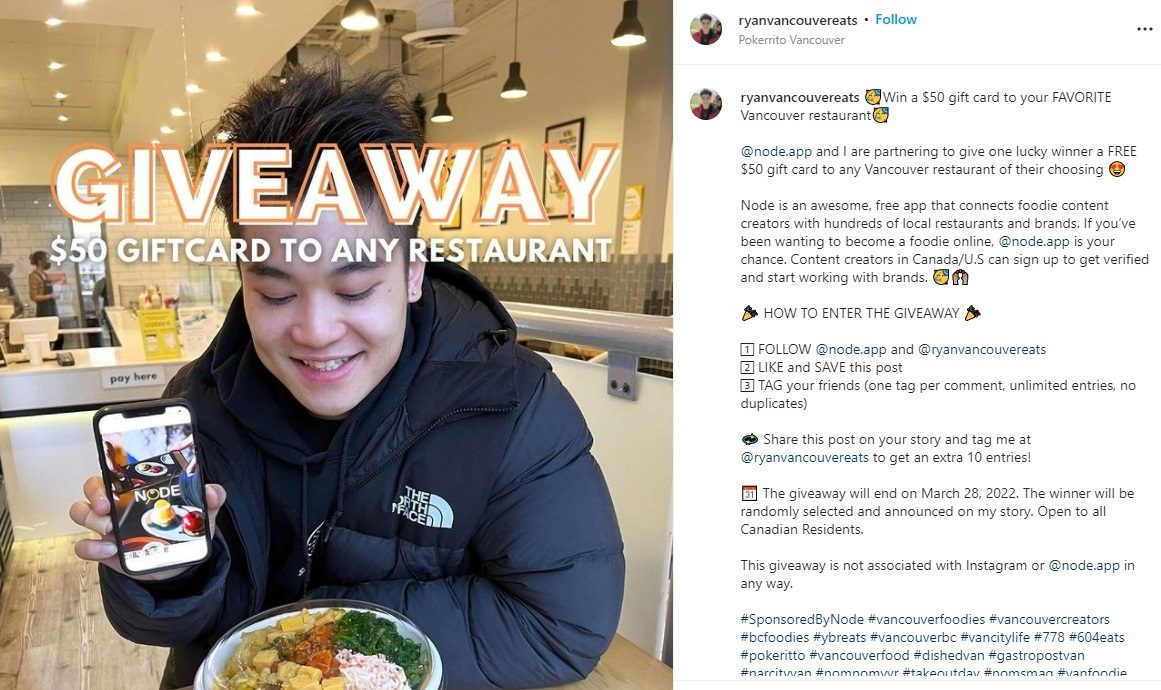
    Influencer giveaway for Node's Vancouver launch

    Leveraging Node for Social Media Giveaways

    If you’re looking to launch a TikTok or Instagram giveaway with influencers, I recommend checking out our platform,Node. We’ve built a robust tool for businesses that lets you find influencers and organize giveaways in little time.

    Whether or not you have a Node account, you can use this article as a resource for organizing your next giveaway campaign. 

    Why do influencers collaborate with brands for giveaways?

    When an influencer and a brand partner together, they both benefit. The influencer receives a product they can give away to their followers without having to pay for it, and in most instances are also compensated by the brand with product or cash.

    This typically involves a random draw/raffle that’s hosted by the creator and posted on their Instagram or TikTok page.

    Meanwhile, the brand gains exposure to a new audience and followers that are genuinely interested in their product (otherwise they wouldn’t enter the giveaway).

    Picking the right influencers for your giveaway

    Choosing the right influencers for your giveaway is essential in order to get the most out of your campaign. Instead of focusing on audience size, look for influencers that have proven engagement metrics, and some affinity with your product or service.

    Engagement > Audience Size

    Social media giveaways with influencers are all about forming relationships with new potential customers and followers. Whether the participants win anything or not, the more engaged they are, the more likely they are to become your customer.

    It can be difficult to read if an influencer’s audience is engaged or passive, but their engagement rate ([comments + likes]/followers) is a quick measure that you can use.

    Look for a relevant niche

    Influencers are real people with social media followings, who usually have very niche audiences. You should think about the type of audience and followers you want to drive to your business when considering influencers for a giveaway collaboration.

    When someone visits your profile page for the first time, they’re often first exploring whether they would want to do business with you. It’s a great opportunity to begin building trust and earning credibility by providing useful and valuable information.

    Targeting influencers in your niche will drive more engagement to your page, and increase your chances of striking a deal. Here’s something a creator recently mentioned to us about their experience partnering with brands for giveaways:

    My favorite social media contests have a purpose beyond just gaining more followers or likes. If a company asks me to participate, I’ll do so if there is a benefit in exchange for my time and effort.

    Content deliverables for giveaways

    Provide deliverables to ensure that your giveaway is presented and executed in a way that considers your objectives as a brand. In addition, If the influencer hasn’t previously created content with your product, you may need to send them a sample as they’ll likely want to create an original photo or video to share your giveaway on social media.

    Contest wording and verbiage

    Rule number one: be clear for everyone, and just keep it simple. The more complicated you make your terms and rules, the more likely you are to get people calling you out on social media and complicating your work. In the worst case, a giveaway gone bad can jeopardize your credibility or cause you to lose customers.

    Giveaway rules & logistics

    This is an example of a brief that we used to organize an influencer-hosted giveaway recently on Node. 
    This is an example of a brief that we used to organize an influencer-hosted giveaway recently on Node.

    Here are some general guidelines for setting the rules and conditions for your social media giveaway. Luckily you won’t need to do much of the heavy lifting if an influencer is hosting the giveaway for you on their page.

    Entry Requirements

    These are examples of rules you can set for people to enter:

    • Tag a friend in the comments, like the post and follow the brand (most common)
    • Share the post in your feed or stories
    • Subscribe to an email list

    Duration

    Indicate the start date and duration of your giveaway. In some cases, you may want your giveaway to coincide with a special event or promo that you’re running.

    How to pick a prize for your giveaway

    Choosing the right type of product for your influencer-hosted giveaways can be tricky. Your giveaway will receive fewer shares If the prize isn’t exciting enough. As a general rule of thumb, I recommend that your giveaway prize be at least $50 in value.

    The larger the prize, the more entries and shares your giveaway will get.  Here’s an example of the terms in a sneaker giveaway that Bodega hosted for Complex.

    To celebrate, we linked up with Stadium Goods to give away a pack of sneakers. You can enter by following both Complex Music and Stadium Goods on Instagram, which counts as one entry. Only one entry is valid for the giveaway. One (1) winner will receive the following pack of sneakers (one pair each):

    Air Jordan 1 Hi OG TS SP (a.k.a Travis Scott x Jordan 1)
    Yeezy Boost 700
    Air Jordan 4 Retro
    Yeezy Boost 350 V2

    The giveaway ends Monday, Aug. 12 at 11:59 p.m. ET. You must be 18 or older and live in the United States to participate.

    Communicate how the prize is redeemed

    If there are any geographic restrictions for participants, you should communicate them to the influencer who’s hosting your giveaway. The last thing you want is an angry giveaway winner writing a bad review or publicly outing you for not receiving their prize.

    How to compensate an influencer for hosting your giveaway

    If you’re hosting a giveaway with influencers, you should be compensating them with products and/or cash. Influencers should be paid fairly for the time they spend creating the giveaway post, writing a caption, and drawing a winner.

    Pricing can totally range depending on the creator’s engagement, audience size, and content quality. As well, they may also have specific pricing packages for partnered giveaways.

    Here are some different ways to pay influencers:

    • One time cash payment
    • Product
    • Performance-based payment (less common)

    Example brief for an influencer collaboration and giveaway campaign.

    Fun ideas for social media giveaways

    Photo Caption Contest

    Asking followers to caption a funny or thought-provoking image is an engaging way to get people to interact with your brand.

    Top Comment Contest

    Another fun way to pick a giveaway winner is by choosing the best comment. For example, coming up with a new product name, or commenting on why they deserve to win the prize. The winner can be based on your own pick or by selecting the top-voted comment.

    Social Media Polls

    We all love to be heard. One way to drive engagement and also get feedback is by asking participants to vote on something in the comments. This can be a new product, style, or feature that you’re releasing.

    Celebrate a New Milestone

    Hitting a milestone is an important event for any brand. Whether it be reaching 10,000 followers or 1,000 sales made, there’s no doubt that this is an important time in your business’s life cycle.  Hosting a giveaway is the perfect way to celebrate and reward your audience for their support.


  • Top 5 Social Media Video Tips for Marketers in 2021

    Top 5 Social Media Video Tips for Marketers in 2021

    When it comes to leveraging social media for marketing campaigns, video content plays an essential role in capturing an audience for the first time. Video has become a winning asset for marketers to boost their campaigns as it’s the most engaging form of media for audiences.

    To put it into perspective, there are over 1 billion hours of videos watched on YouTube everyday. Keep in mind that this number comes from one social platform. Imagine how many hours of videos are being played across other platforms such as TikTok, Instagram, Twitter and Facebook.

    Now that social media platforms have become a chock-a-block place with online videos, you need to make yours stand out!

    Social Media Videos: Do They Matter?

    According to Statista, roughly 3.6 billion people in the world have social media accounts, with Facebook becoming the most-used channel worldwide. No matter the business, social media has been proven as an effective way build an audience from the ground up.

    Due to the massive number of users, social media is a high-potential platform to set a business profile and build an audience base.

    Regardless of the platform, video is king when it comes to engaging people. Whether they’re watching Facebook videos, Instagram reels, or Twitch streams, most people that are scrolling through social media are looking for visually-evocative content.

    How to Optimize Your Social Media Videos

    Making high-quality social media videos can be daunting especially if you’re new to it. After all, you want to wow your audience and give them a video experience they will remember.

    There are many factors to take into consideration when videos for social media. How you shoot your video, what you include in the video, your tone, and the call to action that you use are all important factors. But don’t fret! Here are five easy tips to follow when you’re creating videos for marketing.

    1. Determine your goals

    When creating a social media video, it’s important to have a final goal in mind. Ask yourself, “who is this video for and what am I trying to achieve?.” When you know the purpose of your videos, you can think about the messaging and style that makes the most sense.

    For example, for example if you’re seeking positive reviews about your products to create trust and social proof, testimonial videos can be an excellent outlet to share customer stories. 

    @node.appthanks for the shout out @siempreeco 💛 ##influencermarketing ##marketingtips ##startups♬ original sound – NODE


    2. Convey meaningful stories


    One of the most common mistakes entrepreneurs make when creating video content is forgetting to tell their audience why they should care. Go beyond product features and address the in-depth aspects of your products.

    People love narratives, and your videos should take them on a journey that relates to their particular lives.

    This Adidas commercial beautifully captures the social problem into a captivating story that viewers can agree on. Plastic pollution has been a major problem over the decades, yet there’s no significant move progress being made to solve it. However, Adidas came up with a solution that everyone can relate to.

    This is a great example where the brand has successfully captured the crowd. If you create a meaningful story, you’ll have more chances of getting organic exposure and avoid appearing like a blatant advertisement or commercial.

    3. Win the first ten seconds

     People can scroll past social media posts without giving them another glance. They easily get diverted to the next shiny object.

    The best way to capture their attention is immediately is to create a strong intro. Asking them questions or highlighting their pain points in the first few lines of the video can be a powerful way to convey a message across.  

    Since human attention spans last around 8-10 seconds, it’s crucial to optimize videos within this short time frame so they can stay engaged until the end.

    For example, one of the best first ten-second portrayals comes from Apple commercials. As you can see from the video below, Apple cleverly gives a snippet of the content in the very first of its opening.

    People can resonate well with this video from the beginning as it shows how they overcome the difficulties working at home. As soon as the video plays, you’ll feel a strong connection right away since you’re in the same circumstance.

    Due to the pandemic situation, Apple uses this method to answer any concerning questions and offers a solution to how people can adapt to this new “work at home” environment. The idea is genuine as it presents a stark reality of what people are facing and starts with panic. That’s why the first ten seconds of this video captures the audience’s attention immediately.

    4. Add a clear call to action

    It doesn’t matter how brilliant your social media videos are. If the user is not convinced, you’re losing a potential customer. Therefore, you need to add a clear-to-action (CTA) to your video.

    Using an appealing CTA copy can persuade viewers to take action and enter the marketing funnel for your products or services.

    When you include a CTA, social media users understand where they should go next and what actions they need to do—whether to visit your blog, download your app, or make a purchase. They won’t get misinterpreted if they can understand your guidance through a concise copy.

    5. Create platform-specific videos

    People consume content on LinkedIn much differently than on YouTube. On LinkedIn, users are seeking B2B-related content about jobs, industry insights, webinars, and info related to their profession. Meanwhile, YouTube users mostly use platforms to find videos for entertainment and sometimes education.

    All social platforms are created differently, each of them has different user demographics, interests, preferences and algorithms. 

    While it’s common to repurpose videos across multiple social platforms, you should have one key channel in mind because your video will be less effective if it’s trying to please every social platform.

    Takeaways

    Whenever possible, you should try to propose a solution to the negative issue.

    In some cases, you may be able to offer refunds or discounts to appease the situation. Or, other times, you might want to propose a one-on-one phone call where you can discuss the issue further. 

    Either way, by taking the initiative to offer a solution, you’re showing that your business is proactive and genuinely wants to keep its customers happy. 

    Social media videos can be a powerful tool for marketers to catch more eyeballs. To help you determine which social platforms are best for your videos, check out this infographic below.

    Social Media Videos – 10 Things You Have to Know
    Courtesy of: Breadnbeyond
  • How to Calculate Influencer Marketing ROI

    How to Calculate Influencer Marketing ROI

    Influencers create amazing content. Their deliberately candid photos, taken in places previously exclusive to the Conde Naste crowd entice us to pause whatever we’re doing — usually something non-exotic, not on a beach — and dream.  

    This ultra-compelling content has become a new standard for advertising on social networks, and this trend isn’t going anywhere. 

    The majority of marketers had already begun experimenting with influencers by 2019, and nearly 60% of respondents in a recent Linqia survey said that they planned to increase their influencer marketing budget in 2020.  

    Late-to-adopt brands don’t want to be left out – stuck using traditional advertising and studio images. The preferred social media platform for marketers is currently Instagram, with 97% of marketers planning to use it for their next campaigns. 

    But is FOMO reason enough to hop on the influencer marketing bandwagon? Maybe— If you’re confident that you’ll get a return on your investment.

    Are you seeking awareness, measurable sales, or new website traffic? These are all questions you should ask yourself before you invest in influencer marketing.

    In this article, we will explore different tactics that brands use to track and calculate ROI from influencer marketing.

    Greatest Challenges For Influencer Marketing:

    Choosing the Right Influencers: 

    Before launching an influencer marketing campaign you can do some due diligence that will increase your potential return on investment on individual influencers. Spend time getting to understand the potential ROI of your influencer network.

    You want to partner with creators whose audiences are aligned with your target market, so that you can be sure you’re spending your advertising budget on prospects most likely to purchase from you. 

    You can come up with epic campaigns all day, but if you’re targeting people that won’t buy from you, you’re not going to recuperate your investment through an influencer’s post. 

    Using an influencer marketing platform during this process will save time and make your life easier. These vetted marketplaces connect influencers and brands, and provide access to statistics, demographic insights, and reviews. 

    Find out how we vet our creators and influencers here at Node!

    How to measure influencer marketing ROI
    Content Marketing Institute, 2019

    Tracking & Measuring Influencer ROI

    Besides identifying which influencers to use, the biggest challenge that marketers face is measuring their influencer marketing campaigns’ return on investment (ROI). According to some surveys, up to 90% of businesses don’t feel confident in their ability to do this. 

    Much of this challenge exists because a large part of the return that brands get from influencer campaigns comes in the form of brand awareness. Awareness is higher up in the marketing funnel than, for example, purchases – and therefore less tangible and more difficult to quantify. 

    The social proof you generate from influencers, but it has clear influenc on people’s buying decisions. Social proof simply means having someone else tell you it’s good. Letting your customers know what other people like them like helps build trust, encourages action and inspires others to take new actions.

    There is no silver bullet in tracking the success of an influencer marketing campaign, and your metrics should be guided by your campaign goals. 

    Return on Investment

    Simply put, ROI measures whether or not you make more money on your campaign than you spend on it. It’s how much money you make, minus your costs.

    Measuring Cost

    There are 3 main, bare minimum costs for an influencer marketing campaign. How much you choose to compensate an influencer, the cost of your product, and the time you spend developing your campaigns. 

    Time Spent Facilitating The Campaign:

    If you scale your influencer program correctly, it should require less effort as time goes on. All the formalities can eventually be plugged into a workflow system and streamlined. 

    In the beginning, however, you’ll probably need to spend a good chunk of hours doing influencer outreach and communication, setting up the campaigns, and negotiating contracts. 

    All of this will be factored into your ROI calculations in the form of time spent – either salary or opportunity cost.

    Influencer Fees

    If you’re working with macro-influencers, you’re likely paying a fee – of which the sky’s the limit. You can also go through an agency or platform that will collect a commission of 20-40% of the payment you make to each influencer. 

    When it comes to pricing and bargaining with influencers, you’ll become better with experience as you work with more influencers and develop a budget that meets your marketing goals. 

    If you’re contracting micro-influencers on a TFP (trade-for-product) basis, then you’re paying for the influencer’s services with the product. This means you’ll need to consider the cost of that product and shipping it to the influencer.

    Discounted or In-Kind Products

    How do you calculate sales from influencer marketing?

    Oftentimes the formula is: “use code x to get y% off of product z.” Personalized discount codes are great because you can easily track sales made from Instagram posts – but you will have to factor in y% off of resulting sales into your costs. 

    While promo codes and affiliate links are a method of tracking influencer marketing sales, they can also deter the authenticity of your influencer posts when used excessively.

    Calculating Influencer Sales
    (Instagram post by @wakeupeathis)

    Product Seeding

    If your product is relatively inexpensive, you might want to consider another approach, known as product seeding

    This method involves sending free products to a carefully-selected list of micro-influencers without expectation of anything in return. Influencers that choose to promote your product do so for free and typically forge a more organic relationship with your brand. 

    In each of the last 2 cases, cost is minimal and the return can be delightful for the dollars spent.

    Brand Awareness Versus Direct Response

    Influencer marketing campaign ROI can be organized and categorized in a variety of flows, but we like to break them down into 2 categories: brand awareness and direct response. 

    Brand Awareness Isn’t Always Tangible 

    Think of brand awareness as the return that doesn’t actually involve a sale, but is introducing your brand to potential customers. This is important because people don’t usually become your customers until they interact with your brand between 5 and 20 times

    You have to make people aware of your brand before they trust you enough to buy from you. 

    Brand Lift Studies

    How can you accurately measure how ‘aware’ people are of your brand? 

    One way is with a brand lift study, which uses surveys or questionnaires to measure certain indicators such as the likelihood that someone who sees your campaign will be able to recall your brand, their sentiment toward the brand, or their level of intent to purchase from you. 

    Brand lift studies are great, but they require resources. And even if you can afford to do one, the results are going to be measured in terms of awareness, which you’ll need to translate to a monetary return on investment. 

    If you aren’t ready to spend the money on a brand lift study you can use some of your own proxy indicators to gauge how your campaigns are affecting your brand’s awareness. Below is a list of some examples; in no way exhaustive.

    Awareness Proxy Metrics: 

    Clicks

    How many clicks did your influencer posts receive? This information can be easily pulled from your Instagram analytics dashboard or any other web-analytics tool that you’re using. 

    You can also use free tools such as Google Analytics to find other click metrics such as how many people visited your website from the campaign post and your retention rate with new visitors.

    Follower count

    To accurately measure how much your Instagram follower count grew as a result of a particular campaign, you would need to have a benchmark of the normal growth rate, seasonality, and overlapping campaigns. 

    But if you’re okay with a large margin of error, you can get a general idea by comparing your growth during the campaign to your normal growth rate. 

    Impressions

    Impressions is the total number of times your content was seen, and reach is the number of people who saw it. 

    One way to capture this data is by asking influencers to send you a screenshot of their analytics from their social accounts. 

    Engagement

    The number of likes, shares, comments, tags, branded hashtags, saves, and actual dialog about the product or service being marketed are all important indicators of how well your campaign is getting the word out about your brand. 

    Direct Response Indicators

    When your campaign has a clear call-to-action, the responses you get (or don’t get) are more direct, and can be more easily converted to a monetary value. 

    How many newsletter signups did you obtain from your ads? What is the conversion rate on your new website visitors? How many form submissions did you have on your landing page? 

    These direct responses that people take to your campaigns are easy to track if you designate personalized discount codes or track landing pages for your campaign. 

    Direct Response Metrics: 

    • Your call-to-action in sponsored posts:
      • Newsletter sign ups
      • Clicks to a designated landing page
      • Website visitors
    • Conversions (sales):
      • Dollar amount purchased with a specific discount code
      • Purchases resulting from a landing page that you set up for your campaign 
    Tracking Website Traffic from Influencers
    Your Google Analytics dashboard

    Paid Ad Performance

    Another method to track influencer performance is to compare the content in a social media ad campaign. While your influencer content is making the rounds on social media, why not get a second life out of it? With Facebook’s Creator Studio you can repurpose your content piece in an ad, which gives you more bang for your buck. This tactic can be used regardless of budget or if you are using influencer content to drive organic traffic.

    By repurposing the content in a paid ad you can drive new audiences and test the content for clicks and conversions.  If the content resonates with your targeted audience, it may be time to invest in some form of paid advertising to acquire those users as well as new audience segments that have been inadvertently discovered by the influencer.

    👉 Read how to leverage influencer content for ads

    Another Return to Consider:

    User-generated content (UGC) is a valuable asset for brands. It’s been reported that 40% of brands will repurpose the content their influencers create on the brand’s website, and 30% in emails

    Generating content in-house carries costs related to photoshoots, hiring models, etc., but when you partake in influencer partnerships, it comes with the package.

    Cost savings is a benefit in itself, but an added bonus is that influencers are often better at creating content than brands. 

    They are the customer, so they are essentially marketing to themselves. Over the long haul, this can shift brands’ overall marketing strategy and voice, resulting in an increased relationship between brands and their customers. 

    Check out some case studies of brands that used micro-influencers to make it big.

    There are endless ways that brands find value in their influencer marketing campaigns. It takes some work to create the formulas and figure out how much money certain actions are worth to your brand, but once you determine your metrics, you can capture that value and can be confident you’re getting your return on investment. 

  • 3 DTC Brands That Are Killing It With Micro-Influencers

    3 DTC Brands That Are Killing It With Micro-Influencers

    Influencer marketing has become one of the fastest-growing marketing mediums, and today roughly 95% of B2C marketers have reported working with influencers in some capacity. Furthermore, roughly one-third of marketers prefer working with micro-influencer as authenticity and higher engagement rates have become the priority.

    Let’s also consider that social distancing is creating a massive shift from physical shopping experiences to e-commerce. 

    Then it is no surprise that DTC online businesses will continue to leverage micro-influencers to build connections and establish a reputation with online shoppers. There’s already been a plethora of DTC brands that have scaled and built cult followings through micro influencers. In this blog we will explore 3 pioneers in this innovative marketing technique. 

    We’ve compiled a list of 3 brands who are doing amazing with their micro influencer marketing strategies.

    Interested in learning about how brands have worked with Node micro influencers? Read more here.

    Mejuri’s Stellar UGC Game 

    Mejuri Fine Toronto-based Jewelry E-commerce Company Website Home

    The early days of crowdsourcing:

    User-generated content (UGC) was built into the Mejuri brand and marketing plan. Founded by 3rd generation Jordanian jeweler, Noura Sakkijha, the fine jewelry company was conceived using globally crowdsourced designs and the mantra to ‘make luxury a habit.’ 

    This inclusivity defines the brand from the demand side. It appeals to the modern woman that doesn’t buy into the traditional sentiment that jewelry is to be received passively (in the form of a gift, from a man). The Mejuri woman is independent. If she wants a pair of gold hoops she buys them—  “for her damn self.”

    Lessons learned from supply-side collaboration: 

    While Mejuri has since moved to an in-house design model, lessons learned from the crowdsourcing days remain a fundamental aspect of the brand. Iterate often, and listen closely to customer feedback is part of the founding team’s philosophy.

    In another departure from tradition, Mejuri has adopted a trend well-known in fashion but uncommon in fine jewelry. Instead of seasonal product lines, they release collections that ‘drop’ every other week through their online store. This creates a feedback loop between customers and the brand, which allows Mejuri to accurately gauge what customers want.

    Growing up with the influencers:

    One underrated aspect of the success of brands that were founded over the last 5-8 years is timing. Mejuri’s initial launch in 2013 and the corresponding 2015 re-launch coincided heavily with the rise of Instagram influencer marking. The Mejuri brand started working with what were low key micro influencers at the time, that has since grown to achieve celebrity status. This allowed the brand-influencer synergy to develop in an organic and natural way, which is key for success in the influencer marketing sphere. 

    An inclusive product:

    Mejuri has created a product that is price-inclusive and that everyone wants to post on social media. Their tone of voice is approachable, rather than one of authority. The company uses “real life” and experiential marketing tactics such as their immersive pop-up in New York City, known as ‘The Vault.”

    Mejuri New York City popup experiential IRL jewelry store the vault

    Mejuri understands online shopping and the company regularly activates its micro-influencer network to convey its message. For instance, for this year’s Mother’s Day sweepstakes, Mejuri encouraged people to nominate a deserving mother to receive a free product.

    Efficacy of the crowdsourcing experiment:

    Blurring the lines between customer and ‘part of the team’ is apparent on Mejuri’s social media. The company’s Instagram page has over 770k followers, and by the end of 2019 Mejuri was tagged in over 130k photos. This produces a great portfolio of user-generated content for their eCommerce store, but does it translate to conversions? With over 100,000 people on the waitlists for some Mejuri products, it appears they’re doing something right.

    Mejuri Toronto-based Fine Jewelry Brand Instagram
    @Mejuri


    Mejuri Toronto-based Fine Jewelry Brand Instagram
    @Mejuri

    Daniel Wellington’s Fortuitous Budget Limitations

    Daniel Wellington Luxury Watch E-commerce Company Website Homepage
    Daniel Wellington Watch Company

    Founded by a Swedish watchmaker, named after an English backpacker: 

    In stereotypical Swede fashion, John Filip Tysander entered the watch business after high school

    The Daniel Wellington brand would come later – after Tysander graduated from university, and would be named after an Englishman that the millennial watchmaker would meet while backpacking in Australia. 

    The real Daniel Wellington was actually wearing a Rolex watch with a NATO strap. The simplicity of the design captivated Tysander and inspired him to create what would become a timepiece empire. 

    Inexpensive luxury:

    The Daniel Wellington brand was created as an affordable watch brand with a minimalistic design that mimicked Ralph Lauren and the trending ‘preppy’ style. Although it may not seem, the actual product is made inexpensively in China. However, their nautical beach club design tells the story of a lifestyle based more in the alternative reality of life in squares. 

    Daniel Wellington Luxury Watch Company Beach Club Style Instagram social media Dubai influencer
    PC: @joannejojobi

    Budget restraints that encouraged experimentation: 

    Tysander founded Daniel Wellington in 2011 with $15k. Both the timing and the budget limitations of the brand’s debut as a company was fortuitous. As with Mejuri’s launch, influencer marketing was not yet really ‘a thing,’ and was happening organically at the time. 

    Had Tysander decided to raise venture capital and leverage Daniel Wellington’s digital marketing efforts, the company may have used more traditional advertising and celebrity endorsements.

    Instead, the company pioneered what we now know as micro-influencer marketing. It gave free product to independent content creators in their target market who, in turn, produced fun and creative photos of the watches and posted them on their social media.

    Creative liberty:

    The company encouraged content creation with influencer campaigns such as their “Pic of the Day” contests, which gave its content creators full creative control. This birthed a variety of styles that fit together to create what we know now as the Daniel Wellington style. 

    Daniel Wellington Luxury Watch Company pic of the Day Campaign on Instagram social media
    #DWPicOfTheDay PC: @danielwellington

    This signature collaborative look remains an important feature of the brand today. With almost 5 million followers, 95% of the content posted on Daniel Wellington Instagram account is UGC. 

    Daniel Wellington Luxury Watches Instagram
    @DanielWellington
    Daniel Wellington Luxury Watches Instagram
    @DanielWelington

    Outperforming Rolex in 3 years: 

    Tysander’s bootstrapped startup became the fastest-growing company in Europe in 2013 and held that title for 2 years. By 2014 they had sold 1 million watches, beating Rolex to this milestone by 108 years. The Daniel Wellington brand has become a blueprint for online retailers.

    Reinventing the La Croix feeling:

    La Croix Sparkling Water Company Website Homepage
    La Croix Sparkling Water Company

    From Wisconsin mom’s pop substitute to the “obsessed” Millennial’s Instagram feed:

    You don’t have to necessarily be a new brand in order to become an Insta-famous. La Croix was established in 1981, and was popular for decades among Midwestern moms leading the budget-wise middle America ‘Anti-Perrier’ movement.

    It was the re-brand that coincided with Insta-fame, as well as Americans’ movement away from sugary soda drinks (whose sales dipped to a 30-year low in 2015).  This helped La Croix take over as the ‘all occasion beverage, ’and occasional cocktail mixer in the hands of the 5th largest beverage company in the United States.

    Flavor as a feeling: 

    Check out La Croix’s Instagram feed and you will notice a mosaic of healthy and energetic faces. This is an effort to go beyond marketing La Croix’s tangible as a soft drink. 67% of Americans in 2018 claimed to prioritize health or social consciousness when making food purchases and La Croix wants to fit in. 

    La Croix Sparkling Water Company Instagram
    @LaCroixWater
    Healthy Active Girl Drinking La Croix Sparkling Water Health Beverage Instagram Post
    PC: @catiebergmanoutdoors
    La Croix Sparkling Water Healthy Influencers Skiing and Drinking Healthy Beverage La Croix on Instagram
    #HealthySips PC: @emmadaaniels

    It is a brands’ job to connect the dots here – take that healthy feeling that consumers want to experience, translate it to a visual medium, and message that on social media. La Croix’s parent company, National Beverage did this using the bold and colorful designs “least favored by management,” but that resonated deeply with its audience. 

    #Whole30Approved:

    La Croix’s induction as a Whole30 Partner in Health is like a stamp of approval on every single one of their Instagram posts. If you have any doubts about the soundness of La Croix’s narrative connecting their product with the health-consciousness movement, the Whole30 community is here to ease your mind.

    La Croix Health Beverage Sparkling Water Whole30 Partner in Health
    PC: @beckyb.2.0

    Whole30 also has virality built into the product that helped La Croix’s reach, as it encourages its dieters to share meal plans, recipes and success stories on social media. To date #Whole30Approved has achieved over 467k hits on Instagram. 

    Taking the time: 

    Brands that outperform on social media make an effort to connect personally with their customers— not just sell goods and services. 

    But La Croix is religious about staying connected with their audience. Former digital LaCroix strategist Alma Pantaloukas explained on LinkedIn that La Croix strived for 100 percent consumer involvement by acknowledging all comments about LaCroix and responding to our fans on a daily basis. 

    This is not a small feat, as La Croix’s has over 177k followers on Instagram alone.

    Bottom-up approach to advertising: 

    La Croix doesn’t go out and seek celebrities or macro-influencers to promote their product. It has a much simpler, bottom-up approach that utilizes influencer seeding. 

    They look through their social media at the people that have already posted user generated content, tagging the La Croix brand. They share this UGC from these customers, regardless of their follower count, often sending gratitude gifts such as a voucher for a free case of La Croix. 

    Realization of the anti-Perrier movement:

    The La Croix brand under its original owner was never able to overtake its European sparkling water nemesis, Perrier.  However, it appears that its millennial side has finally seen its best day.

    While National Beverage does not release sales records for its individual brands, it is projected that La Croix holds 30% of the sparkling water market share— double that of Perrier. #LiveLaCroix 

    Healthy Influencer Girls Drinking Sparkling Water Beverage La Croix on Instagram
    #LiveLaCroix PC: @kennedy_taylor11

    How Micro-influencers fits into your brand’s marketing strategy:  

    Now that we’ve heard the success stories, let’s look at how this idea can be replicated for your brand. The tactics we’ve discussed can be used whether you’re a small business or a national electronic commerce brand.

    Tap into your existing market:

    In order to find the most loyal influencers to work with, consider pooling from existing customers. Any brand active on social knows that the solicitations from would-be influencers are never short of supply. 

    The problem is that many of the solicitations come from content creators who don’t understand your product and are simply searching for opportunities to make money.

    There is nothing wrong with paying influencers, but you should look first to the people who know and love your brand. Reciprocate support and build on an existing relationship. 

    Know when to give up creative control:

    Part of having a brand is taking pride in the carefully crafted design of the product, the website, and the social media presence – the branding. But if you’re going to go for it with micro-influencers it’s important to know when to give up creative control in exchange for authenticity. 

    If you are finding influencers correctly, they should be representative of your market. Your influencers are your customers, which means that they know what your customers want to see from the brand.  

    If you’re a direct-to-consumer brand get your market research directly from your consumer:

    Whether it’s direct from an internal representation or indirectly through your micro bloggers – put in the extra work to maintain an open dialog with your customers.

    Ask what they want to see on the company’s social media accounts or in the product. Answer their questions and thank them for their support.  After all, your brand only exists because of them

    Get niche:

    There are so many brands in the world, and they all exist on social media. The only way to stand out is to get a niche and encourage your influencers to do the same. Let them use your platform to express themselves – you’ll both benefit from this. 

    Be human:

    The reason micro-influencer marketing works so well is that people trust other people. In fact, 84% of consumers say they trust peer recommendations over traditional advertising. Why invest in celebrity endorsements when you can tap into avid microinfluencers that your customers trust?

    If you take this approach to branding make sure your in-house representatives stay human, as well. Don’t overuse chatbots and templated answers when influencers and customers inquire about your products. 

    Should I Hire a Micro-Influencer Marketing Agency?

    You should be careful about working with PR agencies as they will essentially assume control of the relationship between your brand and the influencer community.  

    For most agencies, their business model does not incentivize them to spend time garnering stronger relationships between their individual client brands and influencers. 

    Bear in mind every brand faces challenges in measuring the gap between awareness and online sales. After all how do you truly quantify your customer relationships and word-of-mouth marketing?

    Make sure to ask the agency exactly what goes into executing influencer campaigns and who will be responsible for communicating and shipping products to the influencers. 

    Benefits of an Influencer Marketing Platform

    Influencer marketing can be effective for most businesses. But, it’s tricky to pull off. You need to find the right influencers, manage relationships, deal with influencer scheduling conflicts, and more. When you consider everything that goes into an influencer campaign, it’s not surprising that you may want to turn to an influencer platform instead.

    Just sorting through the numerous search results on social media can be a full-time job in itself. That’s why it’s great to have an influencer platform help you handle those tasks so you can focus on building quality relationships with influencers

    Influencer platforms are great— when they work. The challenge is finding the right provider that lets you streamline your influencer marketing workflow and generate content at an affordable rate that you can scale.

    If you’re looking to launch an influencer campaign without spending a great deal of time or money, Node is a free service that connects you to valuable influencers who are willing to share content for products they like. The platform gives you the flexibility to choose your compensation, approve influencers and even launch campaigns across North America that influencers can respond directly to.


  • Influencer Marketing & Product Seeding: How It Works

    Influencer Marketing & Product Seeding: How It Works

    Micro-Influencer Marketing

    There’s no shortage of businesses that have built their brands through social media and the virality of micro-influencer marketing. Micro-influencers on Instagram and TikTok have proven to be extremely effective in building trust and awareness within niche communities.

    Influencer marketing campaigns have typically been built around brands paying creators to post content, appear in events and provide endorsements. However, the rapid rate of expansion in the influencer marketing industry has created new challenges for brands.

    Tracking ROI from an influencer engagement rate has always been an imperfect science. It’s no wonder that 90% of businesses aren’t confident about their ability to measure social media return.

    To make it more difficult, brands have to factor the cost of their influencer deals against their overall social spend.

    How do you maximize your budget and time with the growing list of influencers that are at your disposal?

    What is Product Seeding?

    Product seeding is when a business sends a free product to an individual without any obligation or ask. It may seem overly optimistic, but this is a highly cost-effective approach that more brands are taking.

    Here’s a case study from product seeding campaign with Flourish Pancakes

    Product seeding also allows you to scale your influencer relationships and identify brand ambassadors in the endless sea of micro influencers.

    The idea is to work with creators that are passionate about your product— not just because they’re getting paid. Leveraging your product as compensation for influencer content also allows you to scale your campaigns while remaining cost effective.

    However, it’s not as simple as sending free products to a list of randomly selected influencers. Successfully product seeding influencers requires research and diligence.

    Product Seeding & Micro Influencer Campaigns

    Typically with influencer collaborations, a brand would pay an influencer for creating sponsored Instagram or blog posts. Pricing can range from hundreds to several thousands of dollars.

    This is especially true for macro influencers, which is why product seeding is most effective for working with micro influencers. While it’s still possible to work with macro influencers through product seeding, your response rate may take a hit.

    Micro-influencers provide higher engagement rates and they’re also more open to creating content for brands they genuinely enjoy.

    You should aim for influencers that put your brand before their compensation. Having a budget to pay influencers is a great way to build lasting relationships once you find the right group of content creators.

    Through a product seeding campaign, you can find content creators and initiate a relationship to make sure they’re a fit.

    Product Seeding Food Blogger

    Managing Expectations

    If social media influencers are receiving products with no obligation, what can you expect in return from them?

    A successful product seeding campaign should achieve at least one of three outcomes: content marketing, new sales or product feedback. If you’re not achieving any of these, you’re not doing it correctly.

    As a digital marketer, you need to find micro influencers that are a natural fit for your products. When you can convert an influencer into a potential customer and receive a shout-out, that’s a double-win.

    An influencer that’s not even willing to share an Instagram story might not be a great fit for your product. However, you can use that as an opportunity to objectively ask the influencer for their opinion and feedback about your product.

    Your objective is to offer your product to influencers that could actually be your customer!

    How much do influencers get paid?
    Graph from IZEA – State of Influencer Marketing Report

    What Products Can be Seeded with Influencers?

    Product seeding is effective for consumer categories such as food, fashion, cosmetics, and even technology.

    It’s not exclusive to any particular industry. Brands such as Hello Fresh, NastyGal, and Audible have all built their own network of brand ambassadors through product seeding.

    The biggest key is that you select a product that is aesthetically pleasing in photos and social media posts. When shipping your products to influencers make the package appealing and try to personalize as much as you can. A handwritten note is an easy and effective way to show your thanks.

    Be aware of the associated product and shipping expenses when sending your products to various micro-influencer. Influencers are only one component of your digital marketing strategy and you can’t expect overnight sales.

    How do I find micro-influencers to try my product?

    Having more followers does not equal a greater return on investment. It’s important to find influencers that your target market actually follows. For instance, a children’s toy brand would most likely target influencers that are moms. Or if you own a Mexican restaurant you’d want food bloggers that actually eat Latin cuisine.

    Keep in mind that social media marketing is always more effective when it’s perceived as authentic. Look for influencers that create content around products they actually use. Then evaluate whether their content and style is a fit for your digital media approach.

    We have a roster of hundreds of micro influencers who generate content in exchange for free products! Find out how you can collaborate with them here.

    Hashtags

    Instagram’s hashtag search is the most common tool for finding influencers. Browse hashtags that are within your niche, but don’t be too broad or specific with your search. You should be seeking microinfluencers with the top posts for hashtags that have 10-100K posts

    Finding Beauty Microinfluencers

    Competitors

    Browse the tagged posts on your competitors’ Instagram page to see any micro-influencers they are currently working with. They may have already done most of your work for you by finding quality influencers in your niche.

    It’s totally irrelevant if they are paying those influencers or not— your goal is to find brand ambassadors. If influencers are asking you to bid for their services, they might not have your best interest in mind.

    Location

    If you’re operating a physical business you can still seed influencers. You’ll just need to be more specific with your search parameters. Even if you’re shipping products, having some geographic boundaries for your influencer search will still save you shipping costs.

    A great way to find influencers in specific regions by combining your hashtag search with specific locations. For a broader search, you can also browse by geolocation on Instagram.

    Canadian Beauty Influencers

    Influencer Discovery Platforms

    For marketers, influencer outreach can seem like a daunting task. Oftentimes brands seek influencers because they either don’t have the capacity to create the high-quality content that their consumer base has come to expect or they want to build brand awareness

    You can also use an influencer discovery platform such as Upfluence or Social Bakers. These tools are great for validating micro-influencer engagement rates but you’ll need to analyze each influencer’s content yourself.

    Sure, there are hundreds of platforms you can use for influencer marketing, but the problem is they are usually either too expensive, too unreliable, or you simply don’t have enough time

    How Do We Tackle Product Seeding at Node?

    At Node, we provide a product-seeding platform for over 500 brands across North America. Brands using Node are able to push their own product seeding campaigns and get matched with hundreds of micro-influencers in minutes.

    Feel free to request a demo If you’d like to check it out for yourself.

  • Dealing With Negativity and Rude Comments on Social Media

    Dealing With Negativity and Rude Comments on Social Media

    Whether you’re online as an individual or as a business, I’m sure you’ve heard of the dreaded internet troll.

    Internet trolls are generally defined as people who deliberately provoke other internet users by leaving rude, inflammatory or negative comments on social media.

    These people live to upset others online and make people angry, which means that if your business ever encounters a troll, you might be in for a challenge!

    Other times, you may also end up dealing with angry customers or social protesters while advertising and promoting your business on social media.

    Therefore, we thought it’d be useful to create the following short guide on dealing with social media negativity.

    Keep Your Cool!

    Whether you’re dealing with an unsatisfied customer or a rogue internet troll, the absolute most critical thing to remember is to keep your cool!

    This is especially important if you’re dealing with a business’s social media account.

    Remember that there are always other people watching and reading your social media comments and reviews. There’s nothing more of a turn-off to consumers than seeing a brand verbally assaulting or arguing with a customer, even if the customer was out of line in the first place.

    Rather than losing your cool, make sure to take some time to cool off, collect your thoughts, and make a plan on how you can confront the situation more gracefully.

    Stay Professional

    Even if a social media user says the worst things imaginable about your business, you mustn’t curse or use foul language when dealing with such negativity.

    For instance, if you’re dealing with a bad customer review on your business page, the best approach might be contacting the unhappy customer to validate their claims.

    Indeed, if you are at fault, it might be beneficial to ask them what you could have done to make their experience more enjoyable.

    Regardless, no matter how things unfold, make sure to remain professional at all times!

    Offer Solutions

    Whenever possible, you should try to propose a solution to the negative issue.

    In some cases, you may be able to offer refunds or discounts to appease the situation. Or, other times, you might want to propose a one-on-one phone call where you can discuss the issue further. 

    Either way, by taking the initiative to offer a solution, you’re showing that your business is proactive and genuinely wants to keep its customers happy. 

    Create a Press Release

    When we speak of social media negativity, we’re mostly talking about minor issues like a bad customer review or a negative comment on one of your posts.

    However, there are occasionally more severe PR issues that can be touchier, which may involve harassment, racism, sexism, etc.

    In most cases, if you’re dealing with a negative customer that’s purposefully swearing or offensive, you should report the user or ban them from viewing or commenting on your page.

    But other times, if you’re dealing with an issue where your brand or business made a mistake, one of the best ways to quell the situation is by taking responsibility, offering apologies, and releasing a public press release to explain the problem in full.

    Get Positive Social Proof

    One way to combat negative press and internet trolls is to show your brand in a positive light, and one way to do this is to work with influencers.

    While you may not be able to change the emotions of internet trolls, you can control how your brand image is perceived by your audience.

    Influencers can help you in two ways: they have the potential to generate some positive press and change the perception of your brand, and they can also help you reach audiences that are passionate and interested in your product, making them more receptive to your brand in the future.

    At Node, we support hundreds of brands that leverage our influencer community to product content and positive social proof. Best of all it’s a free influencer marketing tool that any business can use!

    Moving On

    Although any type of negativity towards your brand or business can hurt, it’s crucial to understand that a single bad review or unhappy customer shouldn’t ruin your business or even your social media reputation.

    Even if you are at fault and you’ve made some mistakes, once you’ve confronted the situation professionally, provided the best solutions possible, and gave apologies where they were due, the only other thing you can do is move on!

    Keep creating new content and managing your current customers, hand out your branded business cards and promote your business, and pretty soon, you won’t even remember the negativity at all!

    How to Deal with Social Media Negativity

    For every nice person in the world of social media, at least one or more negative people are likely to cause a problem for your business.

    Whether it’s an unhappy customer, a social crusader protesting your business, or just a negative comment or review, make sure to keep your cool, remain professional and courteous while confronting the situation, and finally, know when to move on!

  • 6 Awesome Free Tools to Start Your eCommerce Business Today

    6 Awesome Free Tools to Start Your eCommerce Business Today

    When starting a new business venture, you need a set of reliable and robust tools to aid the process. If you do not have a huge array of startup funds, this can be tricky. There are other options, however. If you know where to look, you can find an array of free tools and resources to help launch your eCommerce business. We have listed 6 free tools that we’ve tested below for your benefit!

    1. Square Online

    The basis of your eCommerce business is an online store. Unless you have web design knowledge, it is incredibly difficult to build an online store from scratch. This is where platforms like Square Online are perfect. Square Online is a website builder and it offers a free eCommerce solution so anyone can build an online store. The free plan is admittedly limited in it’s features and capacity, however you could use these as the basis for your online store, and build from it as your company grows.

    2. Dark Room

    If you want to get into advanced photo editing and product photo creation, having a photo editor is a great idea. Using a photo editor you can improve the basic quality of your product photos to display on your eCommerce website. Darkroom is a free photo editor that has an amazing set of tools for both photo editing and raster graphics creation. Using this program you can easily edit the basic parameters of photos like color saturation, contrast, and brightness. You can also apply some stylish effects to create cool marketing images.

    3. LogoCreator.io

    Once you have decided on your business plan and products, you will need a stylish and professional business logo. A logo is one of the defining features of your business. It is something that people will recognize and associate with your brand.

    LogoCreator.io is a free online tool that you can use to create a logo. It is easy to use with a drag and drop interface. You can start with a blank canvas and simply drop different items and text in. It also has a cool range of templates that you can use for inspiration.

    4. Canva

    Canva is an excellent free graphics design platform. It has a range of different tools including a branding manager, planner, and thousands of pre-made templates to work with. Using Canva, you can create a wide variety of graphics for social media marketing, and for your new eCommerce website. For example, you can create infographics, Facebook cover photos, product images, and promotional banners. The platform is easy to use, and like LogoCreator, it also uses a drag and drop interface that anyone can learn.

    5. Hemingway Editor

    Having impeccable grammar and sentence structure is vital for launching an online business. Your text must be concise, well-written, and easy for users to digest. This is where a free resource like the Hemingway Editor can help. The Hemingway Editor is a free tool that analyses your written content. Simply copy and paste your text into the document and it will show a variety of improvements. This includes the use of passive tense, excessive pronouns, and hard-to-read sentences. It is an invaluable tool to have if you are not a particularly skilled writer.

    6. Node

    Online stores can be challenging because you need to establish credibility and authority if you want to succeed— which can sometimes be challenging for startups with little to no customers. Having influencers share your brand and content is one way to do this, especially if these influencers have significant reach and followers.

    Luckily you can use Node for free to get high-quality content without paying for posts or third-party platforms and agencies. Best of all, Node lets you work with influencers through product exchange, which makes it perfect for new eCommerce stores. You can even filter and target influencers that are in your niche and within your shipping range.

    Closing Thoughts

    This is just a small sample of free tools available to entrepreneurs. You can use these products to quickly build and launch your eCommerce store without spending any money.

    Website Builder: Square Builder
    Photo Editor: Dark Room
    Logos: LogoCreator.io
    Promo Banners: Canva
    Content Writing: Hemingway Editor
    Influencers: Node App

    In this age of digital marketing and affiliates, you can find many companies that offer their services for free. You just have to know where to look. Why not give these resources a try today and see how they can aid your business development? They may prove invaluable in launching your eCommerce project.

  • 3 Reasons Why Your Brand Needs to be on Clubhouse Right Now

    3 Reasons Why Your Brand Needs to be on Clubhouse Right Now

    Clubhouse is a new invite-only social media platform that has been growing rapidly since it launched in early 2020 and garnered over 10 million users and a valuation of over 1 billion in less than a year.

    The earliest users of Clubhouse were Silicon Valley venture capitalists, startup moguls, and celebrities. The platform has been adopted by several high-profile influencers, including Elon Musk, Kanye West, and Mark Zuckerburg.

    Currently, Clubhouse is only available on IOS devices, but there are rumors about an Android release coming in May 2021.

    Other platforms are also taking notice of Clubhouse and releasing their own features to mimic the app. But the truth is, currently in its infancy, Clubhouse offers an extremely unique opportunity for business owners and their brands.

    Image credit: backlinko.com/clubhouse-users

    How does Clubhouse Work?

    Clubhouse is a voice-based social platform that allows users to host ‘rooms’ that are similar to conference calls, except you have a public stage with designated speakers and moderators that can bring audience members to the stage to speak as well.

    Just like Instagram or Twitter, you have followers and they can see the rooms you’re in as an audience member or speaker. You can also invite them to join your rooms, so if you have a larger audience your rooms can also grow in size.

    Given that people are longing for live events and in-person interaction since the pandemic, it only makes sense that a new app that allows doing just that has grown in popularity.

    Why Should Clubhouse Matter for Your Business?

    Clubhouse is very effective for building engagement within your niche. Listeners have to make an active decision to join a room (unlike Twitter or Instagram content that’s fed by an algorithm), which means that people must be interested in the topic.

    For example, if you’re building a brand for vegans, you can host rooms discussing topics around veganism and attract other avid vegans to join the discussion while establishing yourself as an authority in the space.

    Clubhouse also lets you write a bio (without any character count limits) that you can use to show off all of your accolades and achievements in a readable way, which makes it great for both personal and business branding. They also allow you to link your Instagram and Twitter pages for people to follow on other platforms (which is somewhat contrary to the idea that social platforms don’t want you to leave).

    1. Unsurpassed Networking Value

    The biggest reason people are joining Clubhouse in swaths is for the opportunity to connect with influencers and prominent people in business.

    What makes it so powerful is that it lets people interact through casual conversations allowing for a human connection that’s unachievable through an Instagram photo or TikTok post. In a world where brands are expected to be more self-aware and open with their customers, Clubhouse is the ultimate tool for you to create a human connection with your fans.

    The app is also an outlet for those who are seeking knowledge and connections from like-minded people.  It’s used by celebrities, business owners, influencers, chefs, and a wide gambit of subject matter specialists, which makes it a treasure trove of information for anyone who’s craving knowledge.

    2. Growing an Audience Has Never Been Easier

    How many followers do you have on Instagram? How about back in the day when there were fewer users than today? If you have an audience today, imagine how much bigger your reach would be if you joined Instagram when the platform was brand new.

    Best of all, Clubhouse is a conversational voice-based platform, so you don’t need any help, equipment, or real artistic talent to make great content.

    It allows both budding and veteran content creators to find meaning in the things they’re passionate about—and give their voice a larger arena in which to be heard.

    For savvy marketers, Clubhouse functions as a brand awareness platform for creating organic audio content that sparks dialogue while allowing you to stay at the center of the conversation.

    3. The ‘Halo Effect’ that comes with speaking

    The ‘halo effect’ is a psychological phenomenon that occurs when your opinion of a brand, product, or company is positively affected by the products it produces or things it associates itself with. It’s the main reason why major brands do celebrity endorsements.

    The beauty of Clubhouse still being small is that you’re able to join rooms with prominent influencers that are relevant to your brand or product, and most importantly, you’re able to contribute on stage with your own insights.

    Clubhouse also provides brands with valuable networking opportunities. By joining a room with a prominent business figure or influencer on a topic relevant to your brand, you can offer meaningful and insightful contributions.

    Admittedly, I’ve used the same ‘Halo Effect’ tactic to grow my own Clubhouse audience by speaking at rooms alongside celebrity CEOs like John Leger, Jason Calcanious and Daymond John. Usually, every time I speak in a Clubhouse room I gain 15-40 new followers immediately after

    Influencers on Clubhouse

    Social networks are always changing, and influencers evolve with them.

    We recently saw this leap take place with TikTok, and influencers have been instrumental in helping brands make the migration as early adopters.

    Clubhouse has sparked a similar migration, with influencers building their clout on the platform and establishing themselves as ‘moderators’. At Node, we’ve also enlisted our own group of influencers that we regularly invite to moderate and host some of our discussions.


    Here’s a snippet from the weekly Clubhouse rooms we host at Node


    Join the Official Node App Club on Clubhouse 👋 


  • How Small Businesses are Growing with This 1 Influencer Strategy

    How Small Businesses are Growing with This 1 Influencer Strategy

    Influencer marketing is a 21st-century approach to “celebrity endorsements” that involve product posts from prominent social media figures.

    Brands collaborate with influencers to increase brand awareness, grow their own social media platforms, and focus their marketing to a niche audience by collaborating with influencers in a specific field.

    One reason influencer marketing is so effective is that it puts the relationship in the hands of the brand. This can’t be said for most advertising methods: push an ad out, pray that someone sees it and buys. With influencer marketing, you are connecting one-on-one with your audience to achieve deeper credibility.

    And now, due to the advent of social media, anyone can become a storyteller. Influencer marketing is no longer just for large brands and agencies. Companies can now tell stories by connecting with individuals. Brands have also begun to realize that working with smaller micro-influencers may be cheaper, more meaningful and more beneficial in developing a ​stronger ​bond between brand and consumer.

    In this article, I’ve outlined some strategies to consider if you’re looking to work with influencers on a small-business budget (and will be useful for startups and marketers in general).

    How much does Influencer Marketing cost?

    There are numerous factors that determine how much an influencer collaboration will cost.

    The audience size of an influencer is not the only factor that determines the cost. Just like any job, the amount of time the influencer will spend on the collaboration plays a role in the price they’ll charge. A single post on Instagram requires less time than a YouTube video dedicated to your brand, which will usually be reflected in the cost.

    Influencer marketing can certainly come at a high cost when it comes to collaborating with big-name social media figures. Some influencers charge up to $1 million per sponsored Instagram post.

    Micro-influencers are creators with fewer than 10,000-20,000 followers. Not only are they more affordable, but they also tend to be highly trusted by their followers, have hyper-engaged audiences, and are viewed as more authentic since they don’t have any celebrity status. Their followers see them as relatable which makes them more likely to try a product they recommend. Even big-name brands with larger budgets are gravitating toward micro-influencers because of how effective they are.

    Check out this article to learn more about the benefits of working with micro-influencers.

    When it comes to recruiting micro-influencers, some are willing to be compensated only through free products. This is a strategy known as product seeding or influencer gifting.

    Product Seeding

    Product seeding is the process of sending out free products or gifts to social media influencers, usually in exchange for a post on their platform.

    Every influencer is different when it comes to product seeding. Some creators are happy to take part in the collaboration if they are interested in trying your product. Others can be more reluctant and do not guarantee a post on their platform.

    Because influencers vary in their willingness to take part in these types of collaborations, it is important to discuss the specific details of the campaign so you know what to expect.

    Interesting in learning more about product seeding? Check out this article. 

    How to Reach Out to Influencers for Product Seeding

    If you plan on reaching out to influencers for product seeding opportunities, it is best to be upfront and explain that you do not have a budget for the collaboration but are willing to send free products as compensation. Getting straight to the point and explaining that you see this as a gifting partnership will help you avoid wasting time negotiating a payment.

    Here is a template you can use when contacting influencers:

    Hi (influencer name),

    I was reaching out because I love your content, and I admire how authentic you are with your audience! I was wondering if you would be interested in receiving free products from (your company) in exchange for a post on your feed/story. We’d be happy to send you (product names) for you to try! Let me know if this is something you’d be interested in!

    (Your name)

    After sending a message like this, you can expect some influencers to ask for some other type of monetary compensation. In these cases, you can be honest and tell the creator that you’re a smaller company and don’t have a budget for paid collaborations at this time. Some influencers are more open-minded when it comes to a startup or local business. Other influencers may tell you that they will accept the gift, but will only post if they are truly impressed by the product. In those instances, you can choose whether or not you wish to proceed with the collaboration.

    Where to Find Influencers for Product Seeding

    Reaching out to influencers yourself can be time-consuming and discouraging, especially since not all of them are willing to take part in an unpaid collaboration.

    Because of this, it can be more worthwhile to connect with these creators on platforms that are designated for product seeing and gifting. This will ensure that the influencers you are working with are on the same page as you in terms of it being an “unpaid collaboration.”

    There are lots of great platforms designated for product seeding.

    Node App is a platform that’s built for product seeding and finding influencers for gifting campaigns. The app allows anyone to search for verified micro-influencers based on their niche, amount of followers, engagement, and location. From there, influencers who meet your criteria can opt into your campaign and you’ll be able to ship your product for them to post!

    The main benefit of working with Node is that you already know creators who are signed up for the platform are interesting in taking part in gifting campaigns. This saves you the effort of having to explain what you’re looking for and negotiate with dozens of influencers yourself.

    Social Platforms and Strategies

    Brand collaborations vary depending on the social platform. The differences lie in the type of content, the quality of engagement and certain guarantees that will come from each collaboration. Here are some highlights from the most popular social platforms being used for Influencer Marketing in 2021.

    Instagram


    Instagram offers various types of content within one platform, which can make it overwhelming for marketers to envision their collaboration.

    Instagram’s traditional, grid-photos are ideal for starting a conversation around your product. Other users can like and comment on these posts, making it easy to track engagement. Creators can also include lengthy captions in these posts, which are great to describe your product’s benefits.

    Stories are also an option on Instagram. They are a great way for creators to show themselves unboxing your products, casually discussing the benefits of your product and displaying how your product works. When stories are in the form of videos, they are typically “one-shot,” and don’t involve much editing, making them easier for creators to work on.

    Reels are Instagram’s latest addition, which are less than 30 seconds long and will also appear in the newsfeeds of those who follow the creator. Reels are a perfect tool to showcase your product in action. For example, if you sell a food product, creators could integrate your product within a recipe displayed through a reel. Reels are often more work for creators than other methods since they require more editing and creativity to produce.

    Know Your Goals Before You Approach Micro-Influencers

    When taking the Instagram-route to influencer marketing, it is important to understand that different creators have personal preferences when it comes to the type of content they produce. For example, some creators may not be comfortable writing a lengthy caption on a post if this is not something they typically do. It could come off as very “off-brand” for them.

    Others may be unwilling to create a reel if it does not align with their personal usual content. Most creators charge different rates depending on the type of Instagram content. For some brands, the type of content is imperative to their campaign whereas others are willing to work around an influencer’s preferences. Have a solid understanding of what you want for your campaign before delving into negotiations with creators.

    YouTube


    While there are no time constraints for YouTube videos, most content will fall within the 7-20 minute range. This is significantly longer than the content you’ll see on other platforms, but most brands will only promote their product in one particular section of a YouTube video.

    Since YouTube videos are longer, it is easy for the creator to make more meaningful content surrounding your product. For example, if you are a makeup brand, the creator can showcase a tutorial featuring your product within their routine. Viewers will watch the video for the purpose of learning about the makeup being used, so having your product embedded within that video is a very effective and authentic way to reach your target market. These details make the video valuable for the viewer, which distracts them from the fact that it is a paid brand sponsorship.

    When participating in YouTube collaborations, it is important to find a YouTuber who relates to your product and creates content that your product could be implemented in. YouTube can be a great way to work with a creator who is an expert in your product category, whether it is fashion, beauty, health, fitness, gaming etc. You should discuss content details with the YouTuber to understand how they’ll be showcasing your product, the type of video you’d like your product to appear in and any details you’d like them to emphasize.

    TikTok

    @glamzillaxoIs this actually worth the hype or wut??????I try NEW KVD Beauty Good Apple Foundation Balm! @KVDBeauty #AD #goodapple♬ original sound – GLAMZILLA


    TikTok has quickly risen to popularity as a social platform that features short videos which are 1 minute or less in length. While many influencers have built their name on TikTok, there are questions arising regarding how effective TikTok really is when it comes to influencer marketing.

    One of the biggest differences between TikTok and other social platforms is the fact that it revolves around a For You page, which is essentially content that is highly curated to each individual user. While TikTok has been praised for the algorithm behind the infamous For You page, this aspect of the platform has a few implications for marketers.

    First, the For You page mostly features content from creators who users do not follow. While other platforms revolve around content from those who you do follow, this is a secondary aspect of the content on TikTok. While there are obviously TikTok users who are widely followed, their content is not necessarily showcased first and foremost. In a way, this undermines their influence, meaning a collaboration may not be easily quantified just by their number of followers.

    Second, many TikTok creators theorize that the algorithm actually downplays content that appears to be an advertisement. If there is one thing we know about the TikTok algorithm, it’s that it is incredibly effective at what it does. Avoid language that indicates the nature of the post, such as “sign up for…”, “use my promo code” or “it is only $50!” This is key in the caption, video text, and spoken language.

    TikTok has much more virality potential than other social platforms because their algorithm is based on many other factors besides the number of followers. You’ll see a much wider gap in the views a creator gets on each of their videos. It can be harder to guarantee the level of engagement you’ll actually get from a collaboration. However, this evens the playing field for smaller creators. Choose creators based on the quality of their content and understand if their engaged followers align with your brand and product.

    Creators can leverage popular “trends” on TikTok – this includes sounds, dances, memes etc. Trends change quickly, so it is important to work alongside creators to stay on top of them! Working around a popular trend will help your content appear on more For You pages and get more engagement.

    Final Thoughts

    In conclusion, a small marketing budget isn’t a barrier to working with influencers. Smaller creators and micro-influencers have become popular outlets for content and marketing exposure.

    Major brands are also relying more on micro-influencers because of their high engagement rates and authenticity. Methods like influencer gifting and product seeding make influencer marketing accessible to businesses of any size.

    Communication is always the best policy when discussing gifting opportunities with influencers. Make sure both of you are on the same page when it comes to the details of the campaign and the type of content they’ll be posting. While influencer gifting can work on a variety of social platforms, it is important to understand the key differences between each one so you can choose which one is best for your product.

  • Product Photography: Agency, Freelancer or DIY?

    Product Photography: Agency, Freelancer or DIY?

    Whether it’s setting up your online store, selling your products through Amazon or curating content for your social platforms, there is one common denominator that every business owner will encounter – the need for product photography. When it comes time to launch new products, the process repeats itself.

    Generating photos and videos of your products can be a daunting task, especially when there are so many product photography options. Of course, most businesses are looking for the most cost-effective solution, which means weighing the pros and cons of the typical product photography alternatives – freelancers, agencies, and doing it yourself.

    We’ve compiled a list of some of the benefits and drawbacks of these 3 product photography solutions to help you determine the right option for your business. We’ve also included some resources for helping you move forward with whatever option best suits you.

    Freelancers

    Freelancers can be a very affordable solution when it comes to product photography. While some freelancers have experience in various areas of photography, you can also find niche freelancers who focus on your specific industry.

    When going with the freelancer route, it is important to set certain expectations in terms of project deadline and ownership of the images after the photoshoot has taken place. It’s also a good idea to request a portfolio from freelancers before working with them and inquiring about the quality of equipment they use.

    Lifestyle Photography and Product Seeding

    At one point, business owners were most interested in clean, sleek images of their product without any other scenery or distractions. Now, there is an increasing demand for lifestyle photography in order to capture products in action. These images are more authentic and allow your target market to connect with the product.

    Getting “lifestyle photography” may seem like a challenging task as you’ll need people to be photographed while using your product, and ideally, you’d want images in a variety of settings. Because of this, many businesses feel as though this type of photography is out of reach.

    Product seeding makes lifestyle photography much more attainable for small and medium-sized businesses. If you’re not familiar with the term, product seeding means sending your product to a variety of creators in exchange for content. You can give them a few guidelines if you have specific requests, although they’ll have creative freedom to capture a wide variety of photos of your products in action.

    Here’s an article on how product seeding works.

    This method of collaborating with freelancers makes it easy and affordable to tap into the imagination of a variety of product photographers, generating tons of original content along the way. This is why we’re so passionate about Lifestyle Photography and Product Seeding at Node. We have a network of 700+ creators who do just this and can be accessed through our platform.

    Pros of Working with a Freelancer
    • Flexible in terms of location of photoshoot as well as any other specifications you may have (indoors, outdoors etc.)
    • Can adhere to specific guidelines, or you can leave the creativity up to them.
    • Easy to collaborate with multiple freelancers in order to get a diverse selection of content.
    Cons of Working with a Freelancer
    • Can be harder to verify their work in advance.
    • Fewer formalities regarding the legal and contractual relationship between your business and the freelancer.

    Product Photography Agencies

    There are plenty of great product photography agencies that provide professional, high-quality images for your businesses. Additionally, lots of marketing and advertising agencies offer product photography services.

    Agencies are a reliable, widely-trusted resource when it comes to a variety of business functions. Working with an agency can be best for big projects or an ongoing need for product photography.

    Pros of Working with an Agency

    • Can be highly specialized so you can choose an agency that is most aligned with your niche.
    • Access to high-quality equipment.
    • Some offer in-house studios which are ideal if you need a specific background.
    • May be willing to meet you at a desired location for the shoot.
    • Often provide other services besides product photography which can be beneficial for your business.

    Cons of Working with an Agency

    • Usually more expensive than freelancers.
    • When agencies bundle product photography with other services that you don’t need, it drives up the cost.
    • Many agencies have minimum order amounts, which is a drawback if you’re a smaller business that doesn’t require multiple product SKUs photographed.

    DIY

    Product photography and video creation is not an easy task. There are many nuances that separate good photos from great photos. Sure, it is super easy to get a camera and set it up in your home with a tripod , but how do you make sure that blurry backdrop is crisp and the pictures you get are well lit?

    Outsourcing product photography can be challenging when you’re unable to ship or deliver your products to agencies/freelancers. In situations where you have new products launching several times a year or larger product lines, you may find that product photography is going to become a routine task.

    However, investment in the best (and most expensive) camera gear doesn’t always pay off because you can’t get rid of the bad habits that come with learning how to use that gear.

    Below I’ve included a few guides to help you with DIY product photography. All you need is some determination, the right tools, and some general understanding of photography to start shooting your products.

    Here’s a guide with some tips on how to do your own product photography.

    Not sure what equipment you’ll need? This article outlines what you’ll need to get started.


            Watch this video if you’re shooting your own product photos

    Pros of DIY Product Photography
    • Eliminates costs associated with freelancers and agencies
    • Ensures products are photographed according to all your specifications
    Cons of DIY Product Photography
    • High initial investment when purchasing necessary equipment
    • May need to spend time learning how to photograph your products

    Final Thoughts

    Product photography is not one size fits all – the best solution comes down to your business model, your resources, your needs, and any other specifications you may have. Because of this, understanding the pros and cons of each option is the best place to start when selecting which route is best for you.

    We’d love to hear some of your feedback on what product photography methods have worked well for your business!

  • How To Get Brand Deals as an Influencer

    How To Get Brand Deals as an Influencer

    How do influencers get deals with brands?

    If you’re a micro-influencer or content creator who is looking to get more collaborations with brands, this is probably something you ask yourself regularly.

    Convincing a brand that you are going to be the ideal influencer for their campaign is not an easy task. You have to demonstrate why you’ll be the best choice and give them confidence that you’ll be able to reach and engage with their audience.

    Coming from a team that works alongside brands and influencers to execute marketing campaigns, we’ve seen first-hand what exactly businesses look for when choosing who they want for collaborations and paid sponsorships.

    Just think about it this way – if a brand is going to pick you to market their products, they’ll want to see that you know how to market yourself.

    Here are some tips to help you build a strong brand as a micro-influencer:

    Understand Your Metrics

    Businesses can easily see how many followers you have and how many likes & comments you typically get on a post. What will set you apart from your competition is sharing more meaningful data that isn’t so obvious.

    You should have a solid comprehension of your audience demographics.

    Whether you have over 100,000 followers or less than 2000, analytics can help you showcase that your following is real. There’s no better way to provide social proof for brands that might be considering you as a brand influencer than to be able to show how much online influence and engagement you have.

    This goes beyond just likes and followers. How old are your followers? Where do they live? What gender are they? Businesses want to know these stats before they collaborate with you.

    If you run a major company or brand account on social media, you’re pretty much obliged to rely on these numbers to justify how much you’re paying influencers.

    This guide shows you where you can access more data about your followers.

    Have a Media Kit

    If you were applying for a job, you’d curate a resume to demonstrate your experience, skills, and abilities. Now imagine you were a hiring manager and 10 people walked into your business letting you know they’re interested in getting a job, but only one of them handed you a resume. Who would you hire?

    You’d probably only consider the candidate who gave you a resume. You know they put the most effort into the application process, demonstrated professionalism, and gave you a background of their experience.

    It is the same thing with brand partnerships and collaborations – you should have a media kit to share with potential partners.

    Influencer marketing is hugely popular right now, but you can’t just live on social networks and take pictures of your food for Instagram. You need to show that you can tackle an influencer brief, and you need to show the brands who hire you the analytics from your social profiles.

    Many brands receive dozens of influencer inquiries on a daily basis, so a simple DM isn’t going to cut it.

    Even when brands reach out to you first, having a media kit demonstrates professionalism – they’ll know you’re the real deal. This will be reflected in the offer they give you.

    Not sure how to make a media kit? Learn more here.

    Find your Niche

    As an influencer, having a niche can be incredibly beneficial to your career. It allows you to stand out from the crowd and build a name for yourself in a specific area of interest.

    These days, it’s all about showing brands that you don’t just influence a wide range of topics as most people do, but that you have an area where you can provide unique and interesting insights and knowledge.

    When you begin to post content, be sure that your content has something to do with your niche. If you are a fashion blogger, focus on fashion when posting for the first few months to establish a following based on your niche topic.

    When looking at accounts that are blogging about the same niche or subject as you, follow their followers. These people are interested in the same content and may be influenced by your work.

    How do you stand out as a creator or influencer?

    The answer lies in being as unique as possible. One easy way to stand out is by communicating your niche clearly through each piece of content you share, and more importantly, becoming the go-to account for a large number of people within your target audience.

    To start building a subscriber base, you need to stand out. One way is by creating content that addresses your audience’s specific needs and interests. Pull in search terms, get creative, and connect with other thought leaders in your community.

    Not sure what to pick? Lucky for you, the options are endless – health and wellness, fitness, pets, cars, veganism, beauty, fashion, parenting, gaming etc.

    If you need some inspiration for coming up with a niche, this video offers some great ideas!

    Be Selective about Collaborations

    Once you start achieving a high level of reach across social, you’ll start being approached by brands wanting to work with you. When this happens, it can be a great position to be in because it often leads to well-paid collaboration opportunities.

    It can be tempting to accept any potential collaboration that comes your way. However, choosing the right brand partnership is crucial or else all your hard work will be in vain.

    Focus on partnerships that align with your niche.  Every post on your page takes up real estate, which represents a piece of your value as an influencer.

    You want to collaborate with brands that match your personality and will add value to your audience. Collaborating with every brand that comes your way might not be the best business strategy if you want your audience to take you seriously or attract brands for paid collaborations.

    Be professional and respectful when declining sponsored collaborations, and let them know you don’t think you’re the best fit for their brand. If you can, redirect them to another creator in your network who might be better – maybe next time they’ll do the same for you!

    Key Takeaways

    Your followers are your biggest asset when it comes to your personal brand. Know everything you can about them – businesses will want access to this information.

    Having a strong media kit isn’t optional these days. Influencer marketing is growing, which is good news for you as long as you can compete with other social media creators. Curating a media kit is a great step in the right direction to show businesses that you’re one to be taken seriously.

    Find your niche and stick to it. Focussing on one category will make you an expert in your field and more appealing to brands looking for micro-influencers.

    Check Out: Tips to Grow Your Instagram Engagement from an Influencer!

  • Wondering how we verify creators at Node? Read this

    Wondering how we verify creators at Node? Read this

    Did you know that over 85% of creators that sign up for Node aren’t accepted onto the app?

    As a growing marketing platform in an already competitive space, we are often faced with the challenge of inspiring creators to produce authentic content to reflect the value that they can all provide for our partnered brands.

    There is a sense of responsibility that comes with being a creator on Node, as our entire community defines who we are and what we set out to be. Our goal is to continue inspiring creators to challenge themselves along with their ability to evolve their content and uplift the community.

    Below, we’ve outlined the general requirements in what we look for from our creators to join our app. Of course, there’s no one-size-fits-all approach, as we recognize that every creator has unique, intrinsic qualities that cannot be defined by numbers or a handful of criteria.

    All of our creators are vetted individually by our team to ensure that a creators’ authenticity and individuality isn’t forgotten or missed.

    Content Quality

    Brands join Node because they’re seeking visual content through the lens of creators that are excited to share, experience, and tell a story about their products.

    Your product photos are not only an extension of yourself as a creator, but ultimately a reflection of Node and the value of our creators collectively.

    While it isn’t completely necessary to have professional photography equipment, creators should still ensure that their feeds are aesthetically pleasing and consist of high-quality content.

    Content must be shot under adequate lighting with a focus on the product instead of being distracted by shadows, reflections or graininess.

    A question that we pose ourselves when evaluating content quality (and we encourage you to as well) is whether or not we can envision brands reposting the creators’ content on their own accounts.

    In addition to overall content quality, captions are greatly taken into consideration as well. Are you actually providing in-depth insight to your experience with the product or do your captions simply include a 5/5 star rating? Anyone can sample products and give a recommendation, but an influencer must have influence and trust with their audiences through the power of their storytelling, thoughts, and opinions. After all, one of reasons micro influencers are so effective is because of their hyper-engaged audiences.

    For creators that are verified on Node, we ask that their photo and video quality meets brand standards and the content requests indicated in their claimed nodes.

    Engagement

    We vet and verify every creator by their overall audience size and their relative engagement to ensure that we’re working with real people who have influence in their respective niches.

    Before approving creators, we take into consideration how often they post, their reach (not follower count), their history with their audiences, and the engagement that they’ve generated through their content.

    We do recommend having at least 2000 followers before signing up to get verified. However, the follower to following ratio or follow back rate is largely irrelevant when evaluating content creators.

    To our creators…

    We want to thank you all for the overwhelming response that we’ve received over the past few months through an abundance of applications, inquiries and anecdotal stories of your positive experiences.

    Our community of creators are relentless in doing what they’re most passionate about: creating and inspiring others. So thank you— for allowing us to join you in all of your journeys to evolve and thrive within your crafts.

    We strive to foster an environment that empowers both creators and brands (alongside their respective agencies) to do what they do best; and we will continue to do so.

    We regret that we aren’t able to verify every single creator, although we’re optimistic that there is always an opportunity down the road. We encourage rejected creators to reapply to our platform every 2-3 months for reconsideration.

    Our goal is to continue to create meaningful experiences and build avenues for you to grow as creators. ✌️

    Check out this article featuring some of our top creators!

  • Free Influencer Marketing Tools for Businesses in 2020

    Free Influencer Marketing Tools for Businesses in 2020

    Are you looking for free tools that will help you with your influencer marketing campaigns?

    We all know there is an endless amount of premium SaaS tools that you can use for social media and influencer marketing. But when you’re just getting started with a new marketing initiative, the last thing you want is some expensive software that you’re not even sure about using.

    And if you’re an experienced marketer that’s looking to improve your influencer campaign management, you’re not alone.

    According to a 2020 study, 32% of marketing professionals rate their management of new content creation as ‘fair or poor’, and a mere 8% think they’re generating optimal returns.

    Influencer Marketing Challenges

    Please note that all of the tools mentioned in this article are products that I am either using right now or have in the past. You may find your own alternatives, but I have only included free products that I can personally vouch for.

    Hootsuite

    I use Hootsuite to manage our various social media pages from one place. Their free version allows you to set up a limited number of streams to view and interact with your social platforms (Instagram, Facebook, LinkedIn, Twitter, etc).

    In addition to tracking posts and staying on top of comments and replies, I use Hootsuite to monitor hashtags and topics that are being shared by potential influencers.

    For example, I’m tracking certain hashtags to identify active Instagram influencers in real-time. I also use this for tracking Twitter influencers and trending posts by topic or hashtag.

    I was a freemium user of their software for over a year. Since we have several social streams that we try to keep active now, I’ve upgraded to their $29/month plan.

    The paid version also provides some additional analytics features to track performance across our social platforms.

    Hootsuite for influencer marketing


    Social Blade

    Social Blade allows you to view the engagement rate for any profile on Instagram, Twitter, YouTube and Twitch. Best of all, their social media search and analytics tool come together in their free version.

    Their free influencer analytic tool will provide you with a 30-day snapshot of content creators and their change in engagement rate. They also take a data driven approach to scoring each account with a grade— although it’s unclear how this algorithm works.

    I regularly use Social Blade to double-check the engagement rate for influencers and spot accounts with fake followers.

    It is a great tool for vetting creators before collaborating with them. Read about the in-depth process we take here at Node to vet our influencers here.

    Influencer Analytics

    Webstagram

    Webstagram was the original influencer analytics tool that I was using back when I managed an agency in 2018. They still offer the same core features but have completely revamped their front-end dashboard.

    Webstagram allows you to search for analytics for specific influencers. Their free version is similar to Social Blade, except the interface is more modern-looking. They also provide some additional engagement data on recent posts.

    Note: I recommend using an adblocker when you visit Webstagram.org. Since their product is completely free to use, most of their revenue comes from banner ads.

    Top Micro-Influencer Posts

    Hunter.Io

    Hunter is a tool that’s most commonly used for lead generation and sales, as it essentially allows you to find addresses. Using the free version you can make up to 100 searches per month.

    Hunter is particularly useful for scraping email addresses from websites and blogs. Sometimes it can be a challenge finding the right contact information when you’re reaching out to an influencer.

    You can also use hunter to confirm if you have the correct email address for any influencers in your list.

    Their free version also offers a chrome extension that allows you to pull accurate email information directly from websites that you are browsing.

    Hubspot

    Once you find the right influencers, you need a way to manage all of those relationships and track correspondence. This becomes especially difficult when you have multiple team members working to scale your micro influencer marketing campaigns.

    Hubspot is one of many free CRM tools you can use to manage and organize your connections with influencers efficiently.

    I strongly recommend using a CRM as opposed to Google or Excel spreadsheets to manage your influencer relationships. If you prefer spreadsheets, Hubspot still lets you rearrange and view your contacts tables, as well as export to CSV.

    Hubspot’s CRM tool provides you with all of the features you need to manage your contacts, track correspondences, and even set custom properties to categorize influencers in your database.

    For Gmail users, you can even install their integration to automatically log and track your emails. This means you’ll have an accurate record of all of your email conversations without any manual data entry.

    Hubspot for Influencer Marketing

    What about Influencer Search and Discovery?

    Unfortunately, I have yet to find a free influencer marketing platform that is reliable for discovering relevant influencers in your niche. I welcome you to reach me if you know of a free influencer marketing platform that should be mentioned in this list.

    Based on my experience, most of the influencer platforms that advertise free trials are teasers that don’t offer much up-front value.

    There are hundreds of different influencer marketing platforms available, yet 61% of US marketers have reported that it’s challenging to identify the right influencers for their brand.

    Whether you’re a brand or agency, your best outlet to search for influencers is the old fashioned way—by browsing social media and searching within your existing customers.

    Read my article on product seeding to learn more about finding micro-influencers for your brand.

  • Restaurant Recovery: Leveraging Influencer Marketing During a Downturn

    Restaurant Recovery: Leveraging Influencer Marketing During a Downturn

    It’s day 30 of the California quarantine and still none of us are used to the desolate scenes that were our lively downtowns just one month ago. Everyone is suffering in some way or another, but America’s fastest-growing sector— our service industry — was hit first, foremost, and hardest.

    Restaurants around the world have either been reduced to takeout menus or shuttered completely. Our hearts go out to those who have spent a lifetime creating the atmospheric and gastronomic experiences where we go to spend time with friends and family.

    Humans are a resilient species, always innovating and adapting. We all want to find a silver lining where we can. People in the restaurant industry tend to be particularly resistant to turmoil, whether it’s a cause or an effect of the nature of the game – the long hours, chaos, and the inherent risk of their endeavors.

    Watch our video to see how we have helped businesses throughout the COVID-19 pandemic.

    Why Your Restaurant Should Use This Time to Build Relationships with Local Influencers

    In the midst of all of the suffering and setbacks, those in the service industry with fortuitous timing and or economic circumstances have been able to use this unfortunate and unexpected free time to do various projects that would otherwise take a back seat to the daily grind that is stereotypical of the business. Here are some things that workers in hospitality have been doing to fill the gaps:

    • Remodeling, or just ‘sprucing up’ their spaces
    • Inspecting and rewriting their processes
    • Revamping menus
    • Doubling down on their delivery and takeout options
    • Marketing their brand


    Building & Maintaining Customer Engagement

    While marketing may seem like a strange thing to do when you’re not even allowed to let people in your store, this is actually the perfect time. Marketing is about building relationships and connecting to your customers. Yes, the end goal is to sell, but while you’re not really allowed to make sales, you can refocus on getting to know your customers better.

    Marketing is largely digital these days, even for physical operations, and what better time is there to improve your brand awareness on the internet than when you’re not allowed to leave your home? If you’re not a photographer you can still create amazing content through influencer collaborations, and now is a better time than ever to do it. Here’s why:

    • Restaurants, influencers, and customers all have extra time right now
    • Micro-influencers can provide strong local reach within the city or region that you serve.
    • Screen time is up, but influencers’ rates are down
    • Restaurants are leveraging discounts in order to maintain a revenue stream (albeit at much lower profit margins)
    • You can use this time to form relationships that will continue through the opening of the economy.

    Let me explain.

    Influencer Post Promoting Restaurant Delivery

    Restaurants, influencers, and customers all have extra time right now

    In the absence of endless resources, marketing budgets are a balancing act between time and money – whichever you have more of, relative to the other, dictates your marketing plan. Right now, we have more time and less revenue than is usually the case. Many restaurant owners have time to reach out to content creators and engage with customers online that they’ve never had before. Content creators have more time to create content. And customers have more time to spend on social media, consuming that content (also known as scrolling through their Instagram feed).

    Increased Social Media Usage since COVID 19
    Statista, 2020

    Screen time is up, while influencers’ rates are down

    In the most isolated period of modern history we are turning to social media to connect with our quarantined brethren. For better or for worse, screen time is up, with Instagram engagement on sponsored content increasing as much as 40% and influencers reporting more engagement on their posts. At the same time, influencers’ collaborations with brands have largely been scaled back.

    While reasons for this are obvious – supply chain disruptions, social contact being required for many collaborations, marketing budgets being halted, and having limited studio space – one thing worth noting is that takeout food is easy to shoot solo and doesn’t require studios or models. Influencers’ rates have decreased, but their content is effectively more valuable because consumers are spending more time viewing it. If you have the means and the upper funnel objectives, you should take advantage of this market gap.

    Instagram Restaurant Sticker

    Pro-Tip for Restaurants

    Instagram is making it even easier for customers to order takeout from you, with their new ‘food delivery’ sticker, rolled out on April 15th. click here for more info


    Restaurants are leveraging discounts in order to maintain a revenue stream:

    One of the extremely difficult choices that restaurant owners and managers are being forced to make right now is when to stop running operations – potentially at a loss – in order to keep their employees on staff. Steep discounts can keep customers coming in but at a cost that may be unsustainable to the business. If your restaurant is engaging in this balancing act, try directing some of these short-term losses to your long-term marketing budget by offering these discounts to influencers who will market for you in return.


    Another Pro-Tip for Restaurants

    In addition to browsing Instagram for influencers, you can use Node App to leverage your product for shoutouts and posts from local micro-influencers. Click here for more info

    Node App’s influencer marketing platform (free for restaurants through June 1st) uses only product as payment, so your existing discounts can be leveraged for free advertising.


    You can use this time to form relationships that will continue through the opening of the economy:

    If you think that influencer marketing is something that could benefit your restaurant, use this time to form relationships with content creators, local influencers and your customers – and gain valuable marketing content. Worst case you get free exposure. Best case, you gain new takeout customers and build relationships that will continue to when take-out returns to dine-in.

  • Does Influencer Marketing Work? Here Are The Stats:

    Does Influencer Marketing Work? Here Are The Stats:

    As a business, you might be re-vamping your marketing strategies and be stuck asking yourself; does influencer marketing work?

    As social media has become one of the necessities of marketing today, influencer marketing has grown exponentially over the past decade and has become one of the fastest-growing channels.

    We turn to influencers for recommendations on the best local eats, facial cleansers that can work miracles & everything in between. Despite this, some of us can still be skeptical on whether influencer marketing works.

    Now I know the social media channel can be daunting and skeptical for some, but brands and agencies are increasingly investing more into influencer marketingand there’s a reason why.


    Authenticity is Key

    According to a study done by The Keller Fay Group and Experticity, 82% of consumers were likely to take the recommendation of a micro-influencer.

    Micro-influencers are influencers, often within your local community who specialize and identify in a specific market niche which can range from fashion to food & everything in between.

    We look to them as a source for reliable recommendations because of their authenticity, knowledge and transparency that they have with their followers. These content creators are able to show products and services as part of their everyday lifestyles. In turn, we trust their solutions and recommendations as we relate to them much more than celebrities.

    Another study from eMarketer found that 78% of millennials would not purchase or are indifferent to make a purchase from a celebrity endorsement.

    Brands are able to reach greater audiences through the millions of followers that celebrities have, but the lack of trust that they have within their endorsements greatly affects their engagement rates.


    It’s a Trusted Strategy

    63% of influencer marketing budgets will increase in 2019. (Influencer Marketing Hub)

    The digital era has paved its way into all of our lives and if you can’t embrace it, you might just be missing out on reaping the benefits. The influencer market is not only growing, but the conversions from influencers are clearly worth the investments.

    Additionally, according to Influencer Marketing Hub, 82% of marketing agencies believe that the quality of customers from influencer campaigns are better than from other forms of marketing.

    Linked hand in hand with their ability to curate authentic and transparent content, influencers also shine in being able to drive quality customers to partnered businesses. Quality customers are typically higher paying and cost less in comparison to attracting new clients. This is relevant to all businesses when it comes to focusing on new audiences and honing in on a regular clientele.


    Return on Investments

    A huge reason why there’s so much skepticism behind influencer marketing is from the ambiguity of being able to measure the impact of influencers. It doesn’t have to be difficult though. Be sure to establish KPI’s (Key Performance Indicators) to measure how well influencer campaigns are doing for you. Common KPI’s include:

    • Engagement rate (likes, comments, mentions, shares)
    • Referral traffic (sign-ups, creation of account)
    • Growth of your audience (increase in followers/members)
    • Reach & awareness (views, clicks, impressions)

    Other important criteria included views, impressions and content type. We often attribute social media marketing to not having any tangible proof of whether our strategies worked or not, but this just simply isn’t true!

    Features such as Instagram analytics show you that the proof really is in the pudding. You can view your interactions on a daily basis that include total profile visits, website clicks, and emails along with your total reach & impressions on new audiences.

    If you’re looking for top of the funnel marketing, Instagram is the prime network to be using. You can even take a look at your core demographics along with the growth of your account.

    Additionally, 89% of marketers say that the ROI from influencer marketing is comparable to or better than other marketing channels. (Big Commerce)

    The ROI metrics aren’t equivalent amongst all social media channels. With different platforms come different engagement rates, analytics and methods of measuring them. Both Instagram stories and posts are able to provide measurable ROI through:

    • The link that can be provided in stories by “swiping up”
    • Providing a promo code/promoting an offer in-stores

    Prior to running your campaign, be sure to identify your goals and targets for the social media platform and format that you plan to use.. which brings us to our last point.

    Learn more about how you can measure the ROI on influencer marketing campaigns here.

    Instagram Leads the Way

    78% of brand collaborations that happen on social media are on Instagram. (TechJury)

    With visually stimulating content, it’s no wonder the influencer market on the app is worth $1.8 billion as of 2019. It’s blatantly clear that this is the app that brands need to be on, with blogs coming in at a distant second at 16%.

    Of all of the social media apps, Instagram’s user base has continued to consistently grow as the fastest social network since 2017. The return on social media marketing has greatly outpaced print marketing.

    According to Mediakix89% of marketers said that Instagram is strategically important to their influencer marketing strategy. 

    Participants were able to select multiple networking sites, yet Youtube came in second at only 70%. Marketers are increasingly seeing the value in the influencer space, with more and more itching to build partnerships.


            15 MIN VIDEO: HOW INFLUENCERS HAVE TRANSFORMED MODERN MARKETING


    Key Takeaways..

    Influencer marketing can be likened to a smaller-scale version of celebrity marketing. When loyal followers see recommendations from micro-influencers they’ve grown to know and trust, they’re more inclined to visualize them implementing the product into their own lives.

    With the market steadily growing over the past few years, the opportunities to expand on your marketing strategies are endless. Here’s a round-up of the key takeaways from this article:

    1. We as consumers tend to trust people we relate to in some way or another. Whether that’s having a similar taste in food or appreciating someone’s fashion tastes, audience alignment is important. This is where micro-influencers come in.
    2. Marketers rely on and can vouch for influencer marketing. It’s become an effective strategy for this day & age.
    3. Instagram is where the magic happens. With posts, stories and trackable links, the visual social platform can tell new audiences a whole story.
    4. Measuring your ROI isn’t as complicated as you might think. Analytics tools (especially on Instagram) can help you with tracking the progress of your KPIs (Key Performance Indicators). Whether your goal is to increase brand awareness, create more content or increase web traffic, there are always tools in place to help you see if you’re on the right path.

    How do Node Brands Work with Influencers?

    We’ve facilitated influencer marketing campaigns for hundreds of brands. See our case studies to learn more about our recent campaigns.

  • 5 Influencer Marketing Ideas for Restaurants

    5 Influencer Marketing Ideas for Restaurants

    Brainstorming new ways to leverage influencers for your brand or venue?

    Since releasing the Node beta, over 200 influencer campaigns have been created by our restaurant partners in Toronto, resulting in over 4000 unique Instagram posts from influencers.

    Based on what we’ve observed, we’ve rounded up effective campaign strategies that you can execute with the Node App.

    Ongoing Campaigns

    Don’t have the time to collect more photos and videos for your social accounts? An ongoing campaign puts your content creation on auto-pilot and grows your visibility on Instagram.

    Benefits:

    • Requires little oversight. Set-up your campaign once per month and let the content flow-in!
    • Receive a wide variety of photos with different action shots and angles.
    • Continuously reach new audiences by having your brand regularly shared by influencers.

    How to create an ongoing campaign:

    1. Select a Date Range spanning 3-6 weeks. (you can exclude certain days/hours)
    2. For your node Offering, indicate the items available. Allowing more options = a wider variety of photos.
    3. Indicate any Exceptions to your offering. If your node is only available on specific days/hours— indicate the time or date here.
    4. Influencer Targeting/Radius: Select a wide range to receive more visits and posts.

    Things to keep in mind:

    • If you’re hiring new staff at your venue, be sure to inform them that influencers will be visiting through the Node App.
    • You can always log-in to the app to track posts and repost the influencer content as you see fit.

    Media Events

    Generate content overnight with a one-time media event. Events are perfect for promoting seasonal items and new openings.

    Benefits:

    • Get your venue buzzing overnight with a wave of influencer posts and stories.
    • Show-off your venue’s aesthetic with staged photos and action shots.
    • More control to plan and curate the experience in advance.

    How to create an influencer media event:

    1. For your Date Range, select a single day spanning 1-3 hours. For weekdays, we recommend scheduling your media event in the evening.
    2. In your Offering, indicate that you’re hosting a media event and mention the items being showcased and offered for tasting.
    3. Scheduling your node 1-3 weeks in-advance will provide guests with more time to RSVP for your event.
    4. Visit Limit: Select the total number of influencers you’d like to host. If your goal is to pack the venue, we recommend allowing additional guests.
    5. Use a unique hashtag to track the engagement from your event on Instagram.

    Things to keep in mind:

    • If you don’t want to stall your regular business-hours during a media event, you can section off a part of your venue for the 1-3 hour duration.
    • Use this opportunity to network and connect with your influencer-guests on a more personal level. They might have great feedback to share with you.

    Staged Photography

    Seeking the perfect photo, but don’t have the time or equipment to capture it yourself? Node can help with that!

    Benefits:

    • Save money/time on photography.
    • Get the perfect shot for a specific item.
    • Requires very little planning or preparation.

    How to plan staged photo-shoots:

    1. Choose a Date Range that you would like for the influencers to visit your venue. Keep in mind it can take up to 7 days after their visit for the photo to be posted.
    2. For your Offering, indicate the item(s) that you’re looking to have photographed.
    3. Select the Visit Limit based on the number of photos you’d like to obtain.

    Things to keep in mind:

    • To have your photos to be captured with a specific theme, mention it in the Content Requests.
    • If you have any special props or backdrops, you can ask influencers to include that within their content.

    Grand Opening Event

    You just opened a new venue, you’ve got the food and service figured-out— now it’s time for a grand-opening event. While it may seem like a simple concept, your grand opening is an opportunity to create momentum and drive early success.

    Benefits:

    • Create local interest in the community.
    • Showcase your venue as a fun and exciting spot for social gatherings.
    • Build a strong relationship with prominent influencers in-person.
    • Generate a gallery of creative Instagram posts and stories overnight.

    How to create a grand opening event:

    1. For your Date Range, select a single day spanning 1-3 hours. We recommend scheduling your media event 3-6 days before your official grand opening to the public.
    2. In your Offering, indicate that you’re hosting a grand opening event and offering an exclusive invitation to influencers for an early tasting. Scheduling your node 1-3 weeks in-advance will provide guests with more time to RSVP for your event.
    3. Visit Limit: Select the total number of influencers you’d like to host. If your goal is to pack the venue, we recommend allowing additional guests.
    4. In the Content Requests, be sure to ask influencers to mention the date of your public grand opening in their Instagram posts and stories. Use a unique hashtag to track the engagement from your event on Instagram.

    Things to keep in mind:

    • Including a special offer or promo during the early hours of your opening is a great way to create a lineup that gets onlookers excited.
    • You can ask influencers to mention your grand opening promo for their followers to see.
    • First impressions are everything. Make sure your staff are prepped for a grand opening.

    Design Your Own Unique Influencer Campaign

    There aren’t any rules to how your create your influencer campaigns, and these are just some of the techniques we’ve seen gain traction with brands that are using the Node App.

    You can even combine some of these tactics to create your own hybrid influencer campaign to align more closely with your specific objectives.

    If you have any suggestions that you think should be mentioned in this article, please give us a shout!

  • New Kids on The Menu: Here’s why successful restaurants work with influencers

    New Kids on The Menu: Here’s why successful restaurants work with influencers

    Savory close-ups shots, witty food puns and eclectic reviews have become the secret to a creating a buzz-worthy restaurant. But how exactly has the trend of Instagrammers turned food reviewers, revolutionized the food and beverage scene?


    5 KEY Stats on How Influencers Are Affecting Our Dining Decisions

    1. 71% of consumers are more likely to make a purchase based on a social media references. (Source: Stackla)
    2. Three out of four customers have used Facebook or Instagram to decide on a dining spot, based on comments and photos from others. (Source: Emphathica)
    3. 30% of millennials would avoid a restaurant if they didn’t like their Instagram page. (Source: Zizzi)
    4. The average 18-35 year-old spends over 120 hours each year browsing photos and videos of food on Instagram. (Source: Buffer)
    5. 69% of millennials have photographed their meal at a restaurant. (Source: Maru/Matchbox)


    Food bloggers let you in on their experience with their photos and personal opinions.
    Photo: @eatnmingle

    Instagram Decides The Special of Today!

    People rely on reviews and food influencers more than ever, and it’s largely due to accessibility. Restaurant goers are no longer reading magazines or newspapers to find new dining spots.

    Instagram has become the new food and drink guide. Simply search a restaurant’s location on Instagram, and within seconds you’re able to view a plethora of food photos and reviews from influencers that have visited the venue.

    Influencers are pushing the conversation when it comes to where to eat and drink.  And most often , where we eat can be swayed in the spur of the moment — there’s no denying that craving when you see a mouth-watering sandwich shot, oozing with deliciousness.


    Instagram Influencers and their creative take on promoting your restaurant
    The Beyond Burger’s arrival at Shamrock Burger being presented by @johnxree.

    Using Instagram to Sell An Experience

    Food critics have become a thing of the past, and fewer people are reading publications. The food business has become about not just promoting taste and value, but also highlighting an experience.

    Food influencers are experts at selling an ‘experience’, and the good ones know exactly how to entice their audiences to convey feelings of curiosity and appeal. It’s no secret that foodie pages on Instagram are embellished, but there’s also no denying how perfectly it ties with promoting a restaurant, bar or cafe.

    Consumers are more likely to believe a recommendation from someone they can relate with and a photo speaks a thousand words. That’s why reviews on social media have become more important than ever.

    Influencers Reach Niche Audiences

    Influencers are unique and so are their followers! Everyone has their own distinct preferences, eating habits and dietary restrictions. Food bloggers can appeal to different audiences depending on their content and geographic location.

    There’s passionate foodies and influencers in every city of the world. As well they may focus on specific themes or topics. Popular food-related themes for influencers include health and fitness, vegan/vegetarian, halal and so many others!

    One technique for   restaurants is to target specific demographics of bloggers to build credibility before launching an advertising campaign or opening a new location. Everyone has their favorite blogger that they trust, and influencers have dispelled the trope that all critics are the same.


    Bloggers that tailor their content to reach a specific target audience.
    Cluck Cluck’s and Burgers N’ Fries Forever frequently work with influencers to create traffic for their limited-time menu creations. Photo: @cluckcluks & @burgersnfriesforever


    Social media has changed the way we shop, dine and socialize as a whole. Instagram has over 800 million active users, and it’s been found that the 65% of top-performing posts have featured a product or brand. Over half of the posts shared on social media are intended to promote brands, products or experiences.

    People are ready to try new places if the content speaks, and influencers are the primary vehicle for delivering content in an authentic way.

    Learn some more tips and tricks for restaurants using influencer marketing here! 

    Node is a private platform that connects food and beverage businesses with talented influencers that are looking to collaborate. Interested in joining Node? Contact us to learn more about how you can get involved.

  • How To Create An Engaging Instagram Feed

    How To Create An Engaging Instagram Feed

    Having trouble curating and producing photos that are ‘Instagrammable’? Keeping up with the current trends in social media can be difficult. Especially when you’re trying to model generate engagement similar to the likes of an inlfuencer. Here are some tricks of the trade, that Node has found to be the most successful in producing quality content.

    Having an engaging feed is key for influencers and content creators when it comes to getting product sponsorships and partnerships. Learn more about how you can get more brand collaborations as an influencer here.

    Organization is key

    It’s important to conceive a clear plan and theme that will represent your brand. You want to plan out your goals with your content in mind. Think about questions like:

    • What is your target audience? (Think: the who, what, and where of your content!)
    • What are you trying to achieve with your content?
    • What do you want your content to really say about you/your brand?

    These questions can be difficult to answer, but it’s all about focus. You need to figure out how exactly how you intend to represent your brand visually.

    Another important aspect of organizing is making sure your content follows a clear theme. Think: your content is your message, and your theme is the most effective tool to make your message as cohesive as possible for your audience. Your theme consists of color schemes, POV, photo ideas, caption ideas, etc. Basically, everything that you need to aesthetically stay on brand and on topic. I recommend using apps such as Planoly, Feedr, or Unum, to help drive your brand forward!

    Organizing your content with the help of apps.

    Using the Right Editing Tools

    Editing is a powerful tool to help you produce content that will resonate with audiences. Often times people equate editing to erasing all the imperfections – but that is not always the case!. With editing tools you can create consistent tones and color palettes that will define your brand identity to audiences. Some of our favorite editing apps are VSCOSnapseed and Adobe Lightroom.

    Before and After Editing Process using Vsco
    Photo: eatandtreats

    Photo: eatandtreats

    How to Shoot Content 

    For many, the most time-consuming aspect of creating content is the process of shooting and making use of angles, lightning, and ambiance. Today, we will be talking about two categories; lifestyle and food.

    Food Photography

    In most cases, enclosed detailed shots are the best for shooting food. Because food is usually still, and can involve a lot of shadows the best photos are captured with natural lighting. You should reduce shadows and make sure your food is on a neutral backdrop. Shadows and clusters can be distracting and messy and can really take away from the content that you present. That’s why it’s usually best to avoid flash for food photography.
    Food Flat Lay
    Lifestyle Photography

    Lifestyle shots on the other hand can be more fun and versatile. The trick is to create unique content that is eye catching and different. If you want your instagram photos  to be engaging, then you need to be original and stay true to your brand.

    The atmosphere needs to really get across in your photo, and your surroundings and location can play a huge role in that! If your brand is targeting city-dwellers, and on the go types – maybe you want to shoot content focused in the city.

    If your brand focuses on wellness and being holistic, maybe you want to try shooting in the wilderness or out in nature. That is all to say that, it is important to have lifestyle shots that accurately reflect the brand and audience you’re targeting.


    Lifestyle Food blogger photography

    Photo: @sarahmian

    Write Engaging Captions in Your Posts

    On social media, most of your content will be judged in the view-time of a fraction of a second, and that goes for what you write as well. When your audiences scroll through their feed, your visual content will peak their interest, but your written work is what will keep them engaged.

    You want to make sure your caption assists in maintaining viewership as best as you can. It’s best to keep your audience engaged in a way that makes them feel like the time they spend looking at your content and reading it, is not time wasted. Asking questions, or leaving room for comments, directed towards your followers is a sure-fire way to get responses and gauge interest! Another helpful tip is maintaining relevance.

    Keep a flare of your personality – whether that be your humor, or inquisitive nature. Anything that demonstrates that you have taken the time to truly think about your content, will help show your audience that you put in effort into create quality content that you believed they would like most.

    Stay Authentic with Your Brand

    These are just a few things to keep in mind when exploring ways to create quality content. Making sure you stay on brand and true to yourself is what is of the utmost importance! If you have any tips or tricks yourself that you would love to share with me, please comment below and let me know what has worked best for you!

  • Tips to Grow Your Instagram Engagement from an Influencer

    Tips to Grow Your Instagram Engagement from an Influencer

    Instagram has changed vastly over the past years, and it’s become the fastest growing social platform in the world. With Instagram evolving so quickly, I thought I would share a few growth-hacks I’ve learnt through A/B testing and managing my own influencer account @allyshayung.

    Some of these tactics have aided me, as well as other influencers in our network at Node.

    [Note: If you’re an influencer and haven’t yet been verified to join Node, these tips may come in handy.]

    Quality Content

    Instagram is all about aesthetics, and the most important aspect to drive engagement is the quality of your content. How you present yourself is integral, as attention spans on Instagram typically last for only a few seconds.

    High quality content doesn’t mean that your photos must be shot on a DSLR or professionally edited. Newer mobile phones are also great for social media photography! Through my experiences I’ve found that iPhone X photos perform significantly better than DSLR’s when it comes to engagement.

    Why do iPhone photos perform better than ones-shot on a DSLR camera? The answer is simple — candid photos are more relatable. We all have a stigma against ‘trying too hard to sell’, which is why it’s also important to appear authentic in your photos!

    Even if you’re shooting with a mobile phone, the quality and appearance of your overall feed is key. You can use tools such as Photoshop or VSCO to edit your photos, and create a consistent tone across your content feed. As well, there are a variety of apps that will let you plan and preview your Instagram feed before posting. My favorite is Planoly.

    Learn more about how you can make your Instagram feed more engaging here.

    How do I find good hashtags?

    Instagram lets you share 30 hashtags in each post. For newer accounts, it’s highly recommended that you use at least 15 in each post. You can create a list of 30-60 hashtags that are relevant to your content and brand. Then swap 10-20 them for each post in order to reach new audiences.

    New hashtags can be found by browsing other high-performing Instagram accounts and influencers to see the hashtags they’re using. Anytime you search for a hashtag on Instagram you can view it’s popularity by the total number of posts. There are also a variety of apps that can help you search for hashtags and their popularity. We regularly use Webstagram to search for new hashtags at Node.

    Using a mix of popular and niche hashtags ranging from 5000-2mil+ will allow you to drive more engagement. We recommend the niche hashtags as they allow you to rank higher in the public feed when people a searching for specific hashtags.

    Make sure they’re relevant to your brand— and that there is rhyme and reason to the hashtags you have chosen. You won’t gain followers or engagement from people that aren’t interested in your content.

    Does it make a difference if my hashtags are in the caption or comments?

    According to Eva Chen, head of Instagram’s fashion partnerships; placing yours hashtags in the caption or comments section does not effect engagement or visibility. However, Instagram’s algorithm will simply ignore your tags if you wait too long before posting your hashtags.

    Keep in mind that your content will be shared to more people once you obtain more likes and comments. Instagram’s sharing algorithm considers both overall engagement and the length of time since the content was posted.

    When you receive high engagement from your hashtags, Instagram is more likely to feature your posts on the explore, hashtag and locations feed. In turn, allowing your posts to receive higher reach, and achieve exponential growth.

    Engage and interact with others

    In order to gain continuous engagement it’s essential to like, comment and follow other accounts in your niche. Always reply to comments on your photos. Even if it’s a simply emoji or ‘thank you’, acknowledge other Instagrammers and build on the interaction.

    Also stay on the lookout for other accounts that would be interested in your content, and actively interact with them. Engagement is often reciprocated, and you’ll find that your overall followers, likes and comments will grow if you consistently allocate time to engage with others.

    One great way of engaging with more accounts is by following hashtags that are relevant to your interests. This way you can interact with new accounts that may be attracted to your content. Overtime this regular activity, combined with high-quality content will grow your engagement on instagram.

    Instagram Stories

    Posting on Instagram stories is an effective way to drive engagement and interest to your page. What’s even more effective is creating interactive content that prompts your followers to engage, while keeping them connected to your account..  You can do this through polls, and Q&As which can be created within any Instagram story.

    Giveaways

    Another great way to engage with your audience, while attracting new followers is by hosting giveaways! They can be either planned on your own Instagram page, or in collaboration with another influencer or brand.

    After you spend some time browsing and interacting with other Instagrammers you should be able to find other accounts that align with your values or style. Reach out to them and offer to collaborate on a giveaway that engages both of your followers, and requires entrants to follow your account in order to be eligible.

    This is a great way to generate an increased interest in your page and continue to keep your followers excited for your upcoming posts.

    Use your Analytics

    It is crucial that you go further than just following the advice of others.  You must really gain a grasp of the content that resonates most with your audience.

    You should be regularly looking at the numbers to see what time periods work best, which tags generate the most views, and type of content your followers are most receptive to!

    Making sure that you are following the insights page to become of aware of strengths, trends, and opportunities to improve your engagement. Your analytics will help you plan and produce more effective content.

    I would love to hear your opinions, so comment below with any of your thought or ideas for blog articles you want to read about in the future!